Jumping Mouse Tracks vs. Vole Tracks
It seems differentiating between Jumping Mice (Napaeozapus insignis and Zapus hudsonius) and Voles (Microtus pennsylvanicus and Clethrionomys gapperi) in my area is a persistent struggle. I have confused them on study calls and most recently on another TCNA Track and Sign evaluation (earning me 99% instead of 100%). With this latest affront to my pride I decided I needed to work through the tracks with more focus and practice seeing the minute differences of these minuscule tracks.
First, lets dig into these species a little bit more. All Jumping Mice and Voles are part of the taxonomic Order : Rodentia, though the Jumping Mice are in the Zapodidae family, and the voles are in the Cricetidae family. Basic and notable differences between them can be seen in their overall size difference, the length of their tails, the size of their hind feet and the number and position of their teeth. Let’s start getting into group and species specific distinctions.
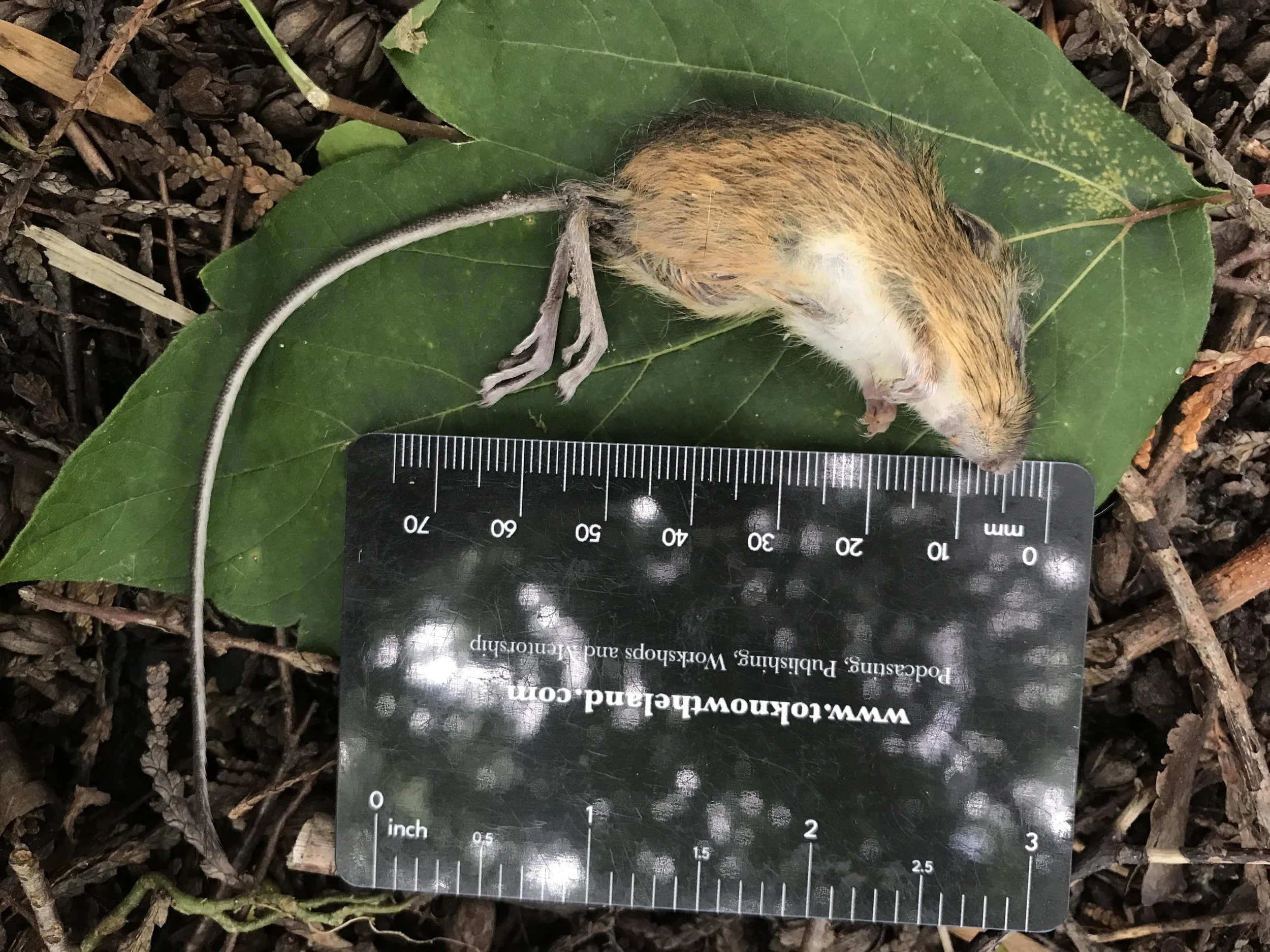
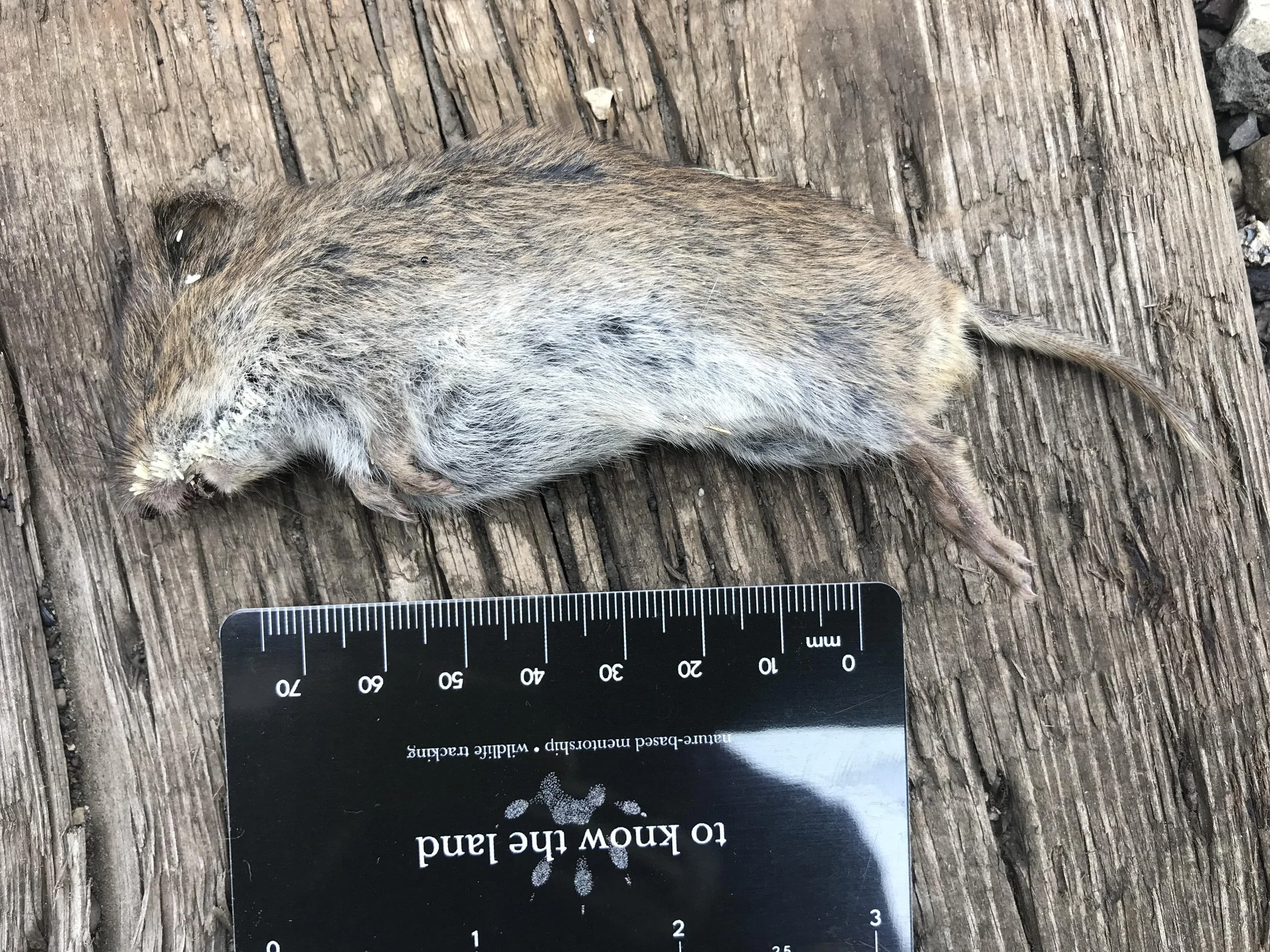
The Jumping Mice in my area are the Woodland Jumping Mouse, Napaeozapus insignis, and the Meadow Jumping Mouse, Zapus hudsonius. The Voles in the area are the Meadow Vole, Microtus pennsylvanicus, and the Southern Red-backed Vole, Clethrionomys gapperi.
Dental formulas :
Meadow Jumping Mouse : i 1/1, c 0/0, p 1/0, m 3/3 = 18
Woodland Jumping Mouse : i 1/1, c 0/0, p 0/0, m 3/3 = 16
Meadow Vole : i 1/1, c 0/0, p 0/0, m 3/3 = 16
Southern Red-backed Vole : i 1/1, c 0/0, p 0/0, m 3/3 = 16
(Learn more about dental formulas here.)
Jumping Mice have larger hind feet than most other rodents around their size, and Voles have smaller feet, about average relative to their size compared with other similar rodents.
Let’s start with looking at the Jumping Mice tracks, which are pretty indistinguishable between the two local species.
The Jumping Mice

Note how long the hind tracks are!
Similar to other Rodents they have tracks that tend to show four toes on the front feet (the much reduced, vestigial toe 1 does not show up in tracks) and five on the hinds. The middle toes on the fronts, toes 3 and 4, tend to point forward at an angle to each other creating a V shape. Toes 2 and 5 on the smaller front feet tend to angle outwards at 180° from each other, or bend back even further. The fronts as a whole tend to show up angling outwards, away from the midline of the trail.
The hind tracks are where we see a bigger distinction from the voles. The Jumping Mouse hind tracks are odd looking for rodents in that the middle three toes (toes 2, 3, and 4) are long and connecting with the metatarsal region on the foot create the appearance of a stretched out foot, and narrowing “neck” between toes 1, 5, and toes 2, 3, and 4. These long hind tracks on Jumping Mice can be over 1 cm long.
If toes 1 and 5 are missing from the track, Jumping Mice tracks could be mistaken for a small songbird.
Track sizes :
Woodland Jumping Mouse and Meadow Jumping Mouse
Front: 1 - 1.6 cm (⅜ - ⅝ in) L x 1 - 1.6 cm (⅜ - ⅝ in) W
Hind: 1.1 - 2.2 cm (½ - ⅞ in) L x 1 - 1.7 cm (~½ - 11⁄16 in) W
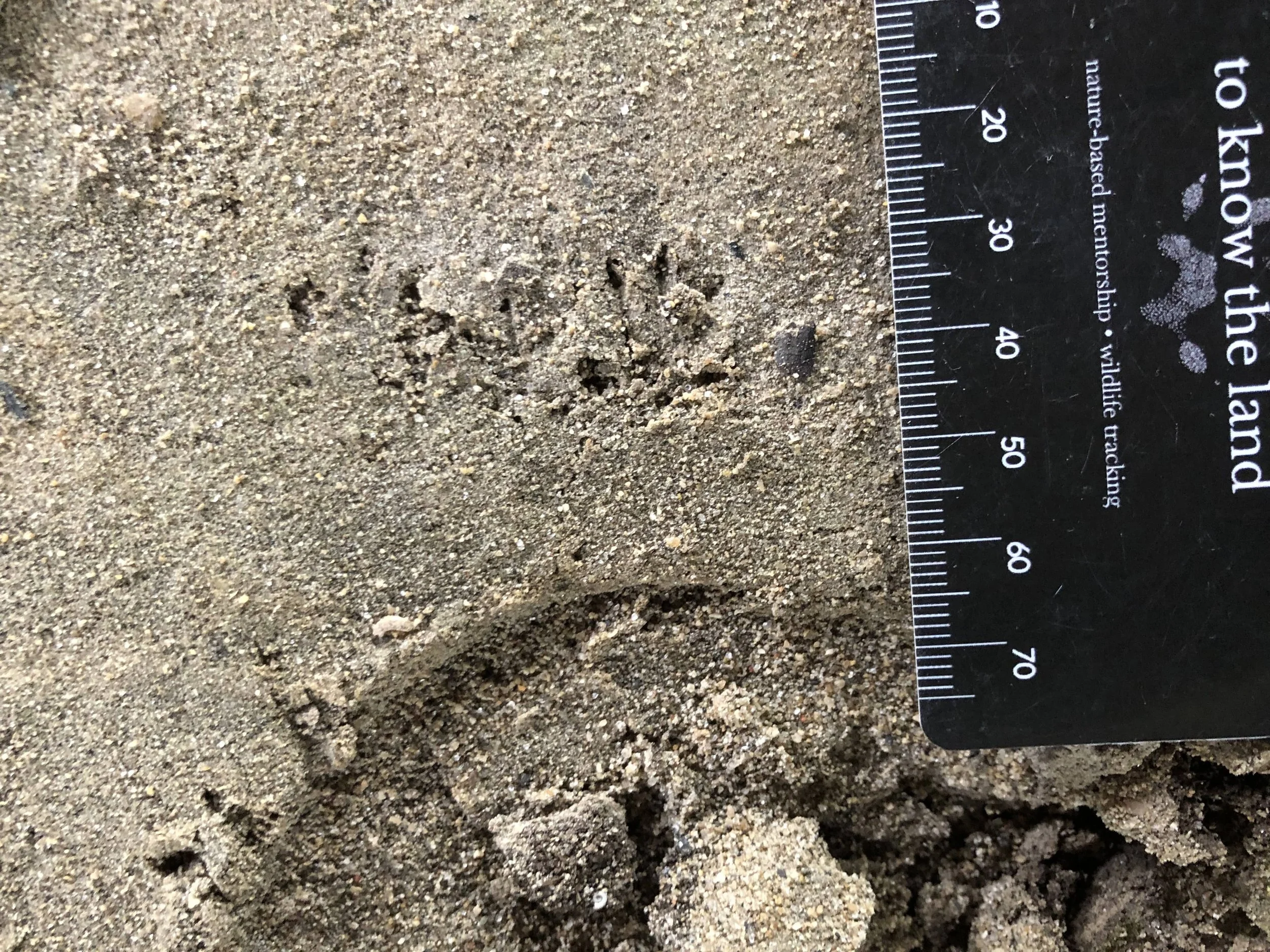
Trail width of this bound is ~4 cm (1⅝ in)
The Jumping Mouse baseline gait is a bound. This is sometimes conventional in form, though often it’s a little bit of an odd bounding shape compared with other rodents like mice, voles, or squirrels. Often, though not always, when the fronts land they tend to face outwards from the mid-line of the trail and they do not often land side by side, instead appear slightly staggered with one foot set a little ahead of the other. When the front feet leave the ground and the hinds land, instead of a conventional bound with the hinds landing ahead of the fronts, in Jumping Mice they tend to frame the fronts, landing beside them.
The Voles
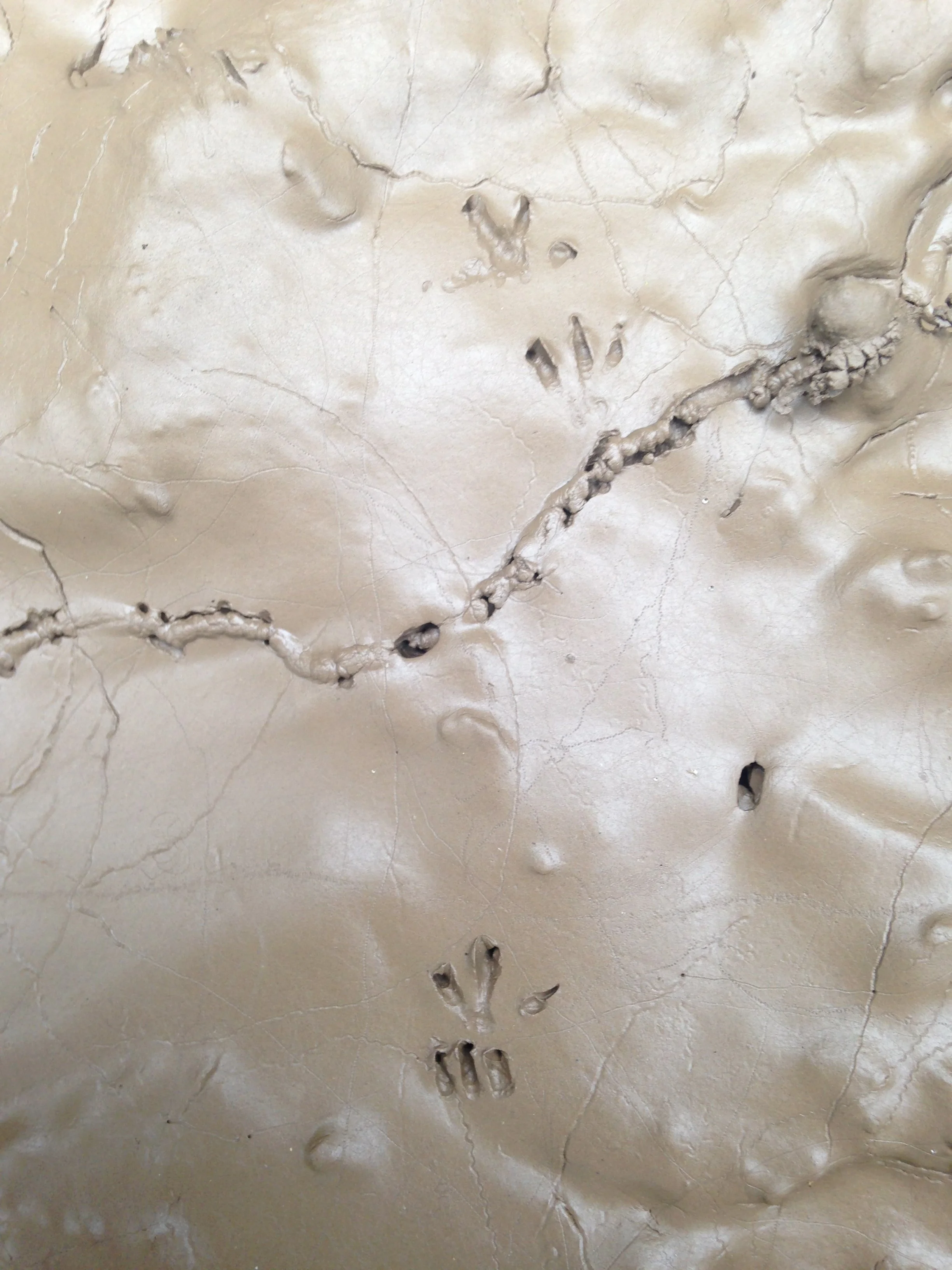
Partial tracks with the right front above the right hind.
Track sizes :
Meadow Voles
Front: 0.6 - 1.3 cm (¼ - ½ in) L x 0.7 - 1.4 cm (~<¼ - ½ in) W
Hind: 0.6 - 1.7 cm (¼ - 11⁄16 in) L x 0.6 - 1.6 cm (¼ - ⅝ in) W
Southern Red-backed Voles
Front: 0.6 - 1.1 cm (¼ - 7⁄16 in) L x 0.8 - 1 cm (~<¼ - ⅜ in) W
Hind: 06. - 1.3 (¼ - ½ in) L x 0.6 - 1.1 cm (¼ - ~½ in) W
A trotting vole, heading towards the top of the image.
Overall the tracks of the Vole have a common rodent structure with four toes showing on the fronts and five on the hinds. Toes 2 and 5 on front feet point out towards the sides, while toe 3 and 4, the middle toes, tend to point forward at an angle to each other creating a V shape. Their fronts also tend to have a longer narrow palm pad, which is longer than wide as opposed to Peromyscus mice who have palm pads which are wider than long.
In the hind tracks, the three middle toes, 2, 3, an 4, point forwards, sometimes at an angle. On the hinds, the metatarsal pads may also appear longer and narrower than the wider pads for Peromyscus mice.
On both fronts and hinds, the long slender toes of voles is of a consistent width throughout the entire length as opposed to Peromyscus mice who have bulbous toe pads. All feet are also ribbed along the length of the toes.
Voles tend to trot more than bound. The trot is their baseline gait, though they will bound in open areas to get undercover.
I am thinking at this point it would be good to look if there is any difference in the trail width of a bound between Jumping Mouse and a vole?
Trail Widths
Jumping Mouse:
3.8 - 5.7 cm (1½ - 2¼ in)
Meadow Vole:
3 - 3.8 cm (~ <1¼ - 1½ in)
So this is helpful. The low end cut off of the Jumping Mouse is the high end cut off of the Meadow Vole. If there is uncertainty between the two possible groups then the trail width can be a determining factor. My knuckles, proximal interphalangeal joints to be specific, are relatively 2 cm wide across both of my hands on all the fingers except the thumbs (toe 1) and the pinkys (toe 5). I can then be relatively certain that if a bounding trail of a possible Meadow Vole or Jumping Mouse is wider than two of my knuckles, than the animal that made the tracks will be a Jumping Mouse. This is so very helpful.
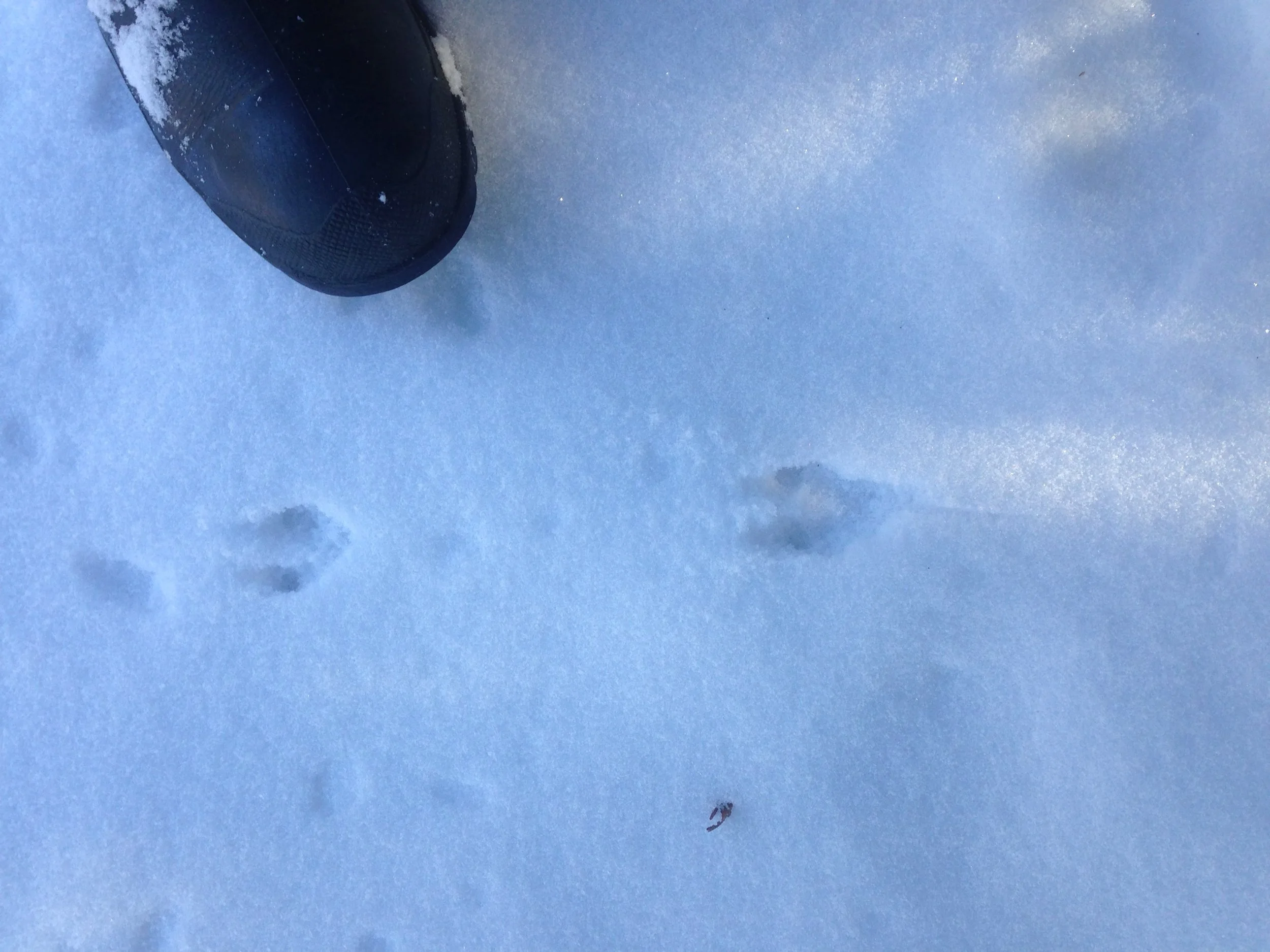
Meadow Vole bounding in snow heading from right to left.
Lastly, an important distinguishing factor would be season. While voles are active all throughout the year, Jumping Mice are true hibernators and it is unlikely we’ll find their tracks in the snow.
I am grateful to have confused the two species on the recent Track and Sign evaluation, enabling me with motivation and determination to further look into these two animals and inspiring me to focus on their different track morphologies. Thank you to Sage Raymond, our evaluator, and to the Jumping Mice and voles who left their trails behind for us to learn from.
To learn more :
A Basic Guide to Non-Human Mammal Dentition
Animal Skulls by Mark Elbroch, Stackpole Books, 2006.
A Perfect Storm of Jumping Mice - a blog post by Linda J. Spielman
Mammal Tracks and Sign by Mark Elbroch and Casey McFarland. Stackpole Books, 2019.