Black Bear Cambium Feeding in Ontario?
Many current and former Earth Tracks Tracking Apprenticeship apprentices were participating at a recent Track and Sign certification in Parry Sound, Ontario evaluated by Sage Raymond. On the second day of the evaluation, there was sign on at the base of a Eastern White Cedar (Thuja occidentalis) where a good tall triangular section of bark was missing and the remaining bark had begun lobing over towards the exposed wood. The cambium layer, sometimes called sapwood, where the tree sends nourishing sugars up from the roots out to the shoots and leaves of the tree, was missing. This wound seemed to have occurred a while ago, and, as noted above, the tree was healing as the remaining bark was enclosing the wound.
Above and also to the sides of the lobing over bark, there were some longer stringier strips of bark which were dangling from the peak of the wound. There also appeared to be some sort of epicormic growth at the peak, where newer, smaller branches were growing in response to a wounding in the tree. Sage considered this a bonus question, a really hard question, in the evaluation and took multiple answers, none of which I proposed. One of the purported causes of the sign was Black Bear (Ursus americanus) feeding on cambium, a behaviour I have heard about and seen photos of before, but never witnessed here in Ontario.
Sage Raymond is an accomplished tracker, the only Canadian evaluator with Tracker Certification North America (TCNA), a Bear guide out West, where she leads groups out through wildlands to encounter Bears safely. I believe she knows what she is talking about and has a lot more experience than I do. But, and I bet you knew that was coming, I felt and still feel a little iffy on the possible Black Bear cambium feeding as a possible behaviour which created this sign. So, I decided on that day of the evaluation that I will do my best to learn more about Black Bear cambium feeding sign and see if I can find more examples here in Ontario.
Firstly, I want to acknowledge a few things. I got the question wrong, and sometimes when we get things wrong, our egos can get a little bruised or wilty. I want to remind myself of that and hold on to that knowledge while trying to research. Am I just frustrated I was wrong or am I looking to deepen my understanding of another animals behaviour? Personally, I am so grateful to learn new things, and am pretty stoked that trackers may have noticed a possible behaviour of Black Bears in our region that naturalists of all sorts have failed to spot up until now that it’s pretty exciting to be wrong here. Or instead of “being wrong”, to be learning something new. It’s not about boosting my ego, more so getting to know the eco.
Fast forward a couple of weeks and the Earth Tracks Tracking Apprenticeship is out again, this time at Noisy River Provincial Park, along the Bruce Trail when following an older snowed in canine trail two colleagues came across more sign just like the possible Black Bear cambium feeding we saw up in Parry Sound!
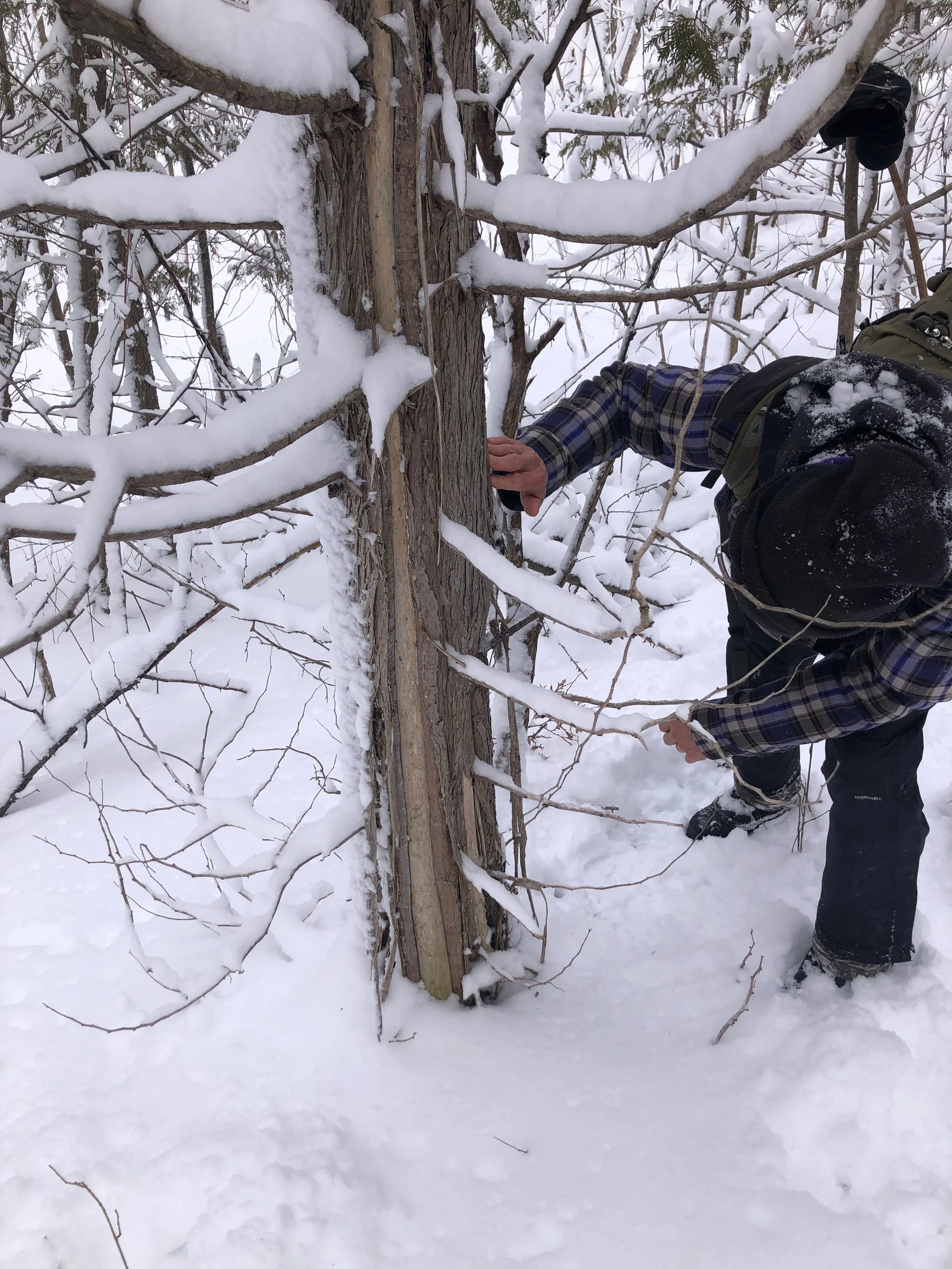
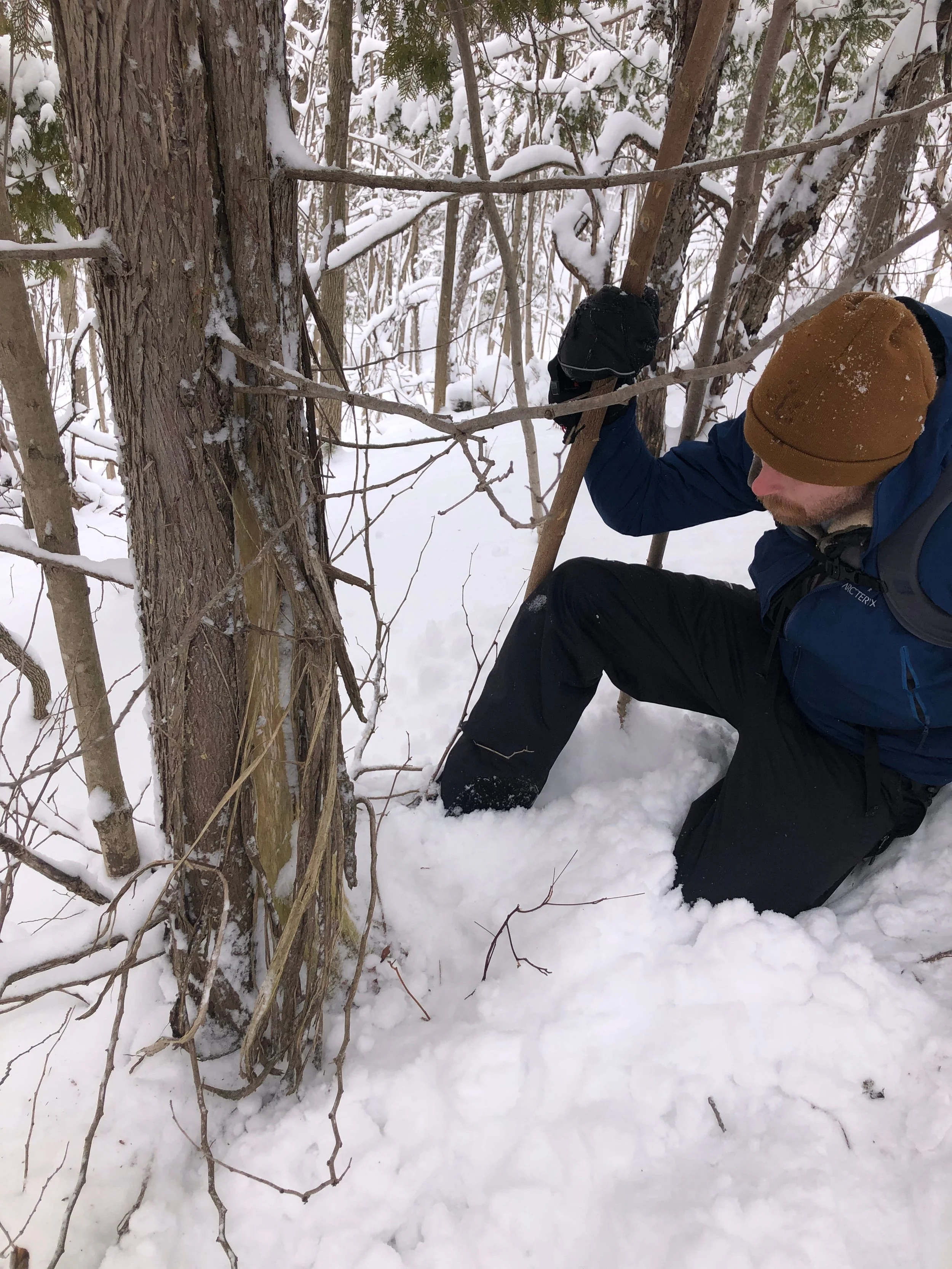
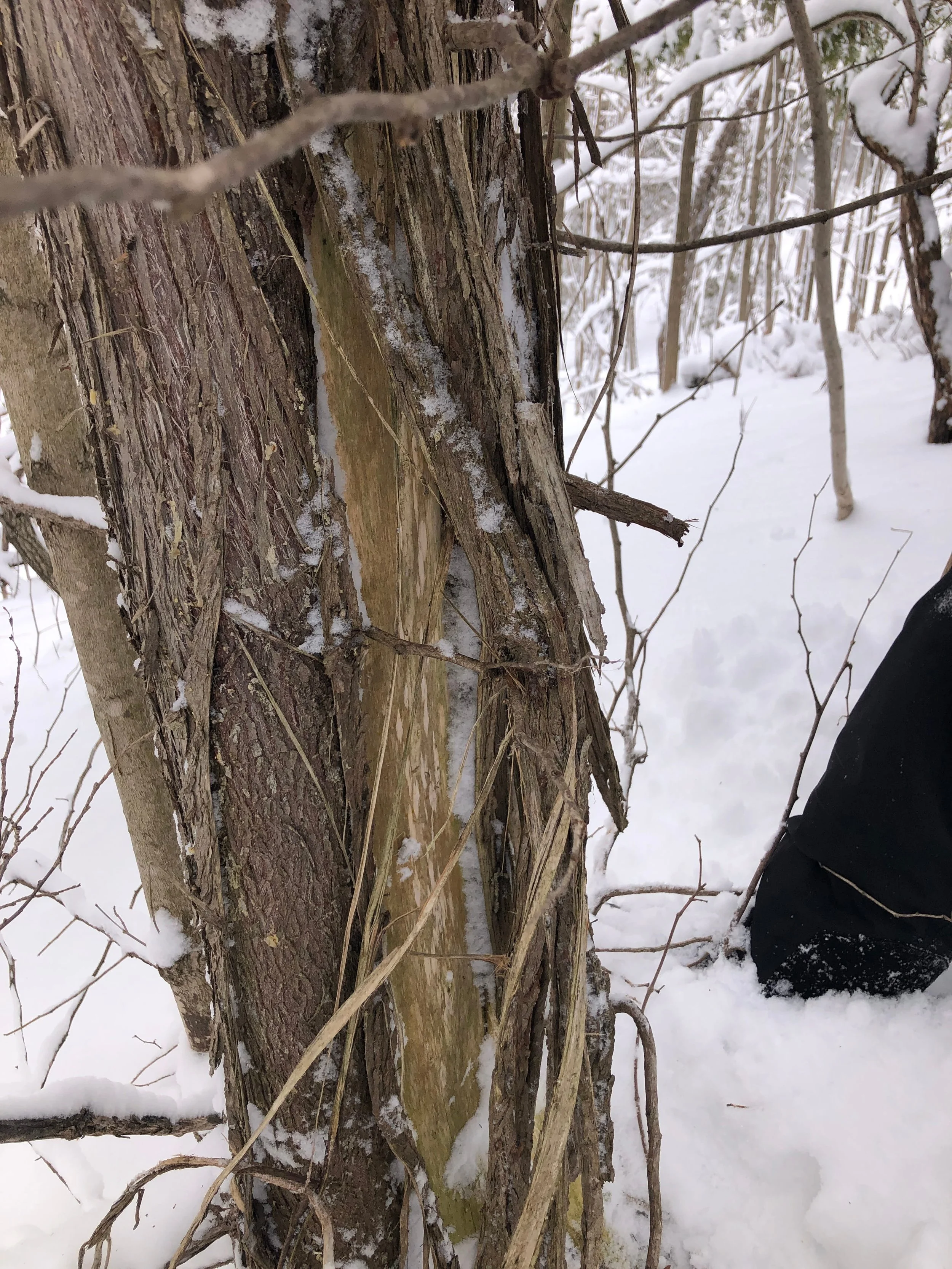
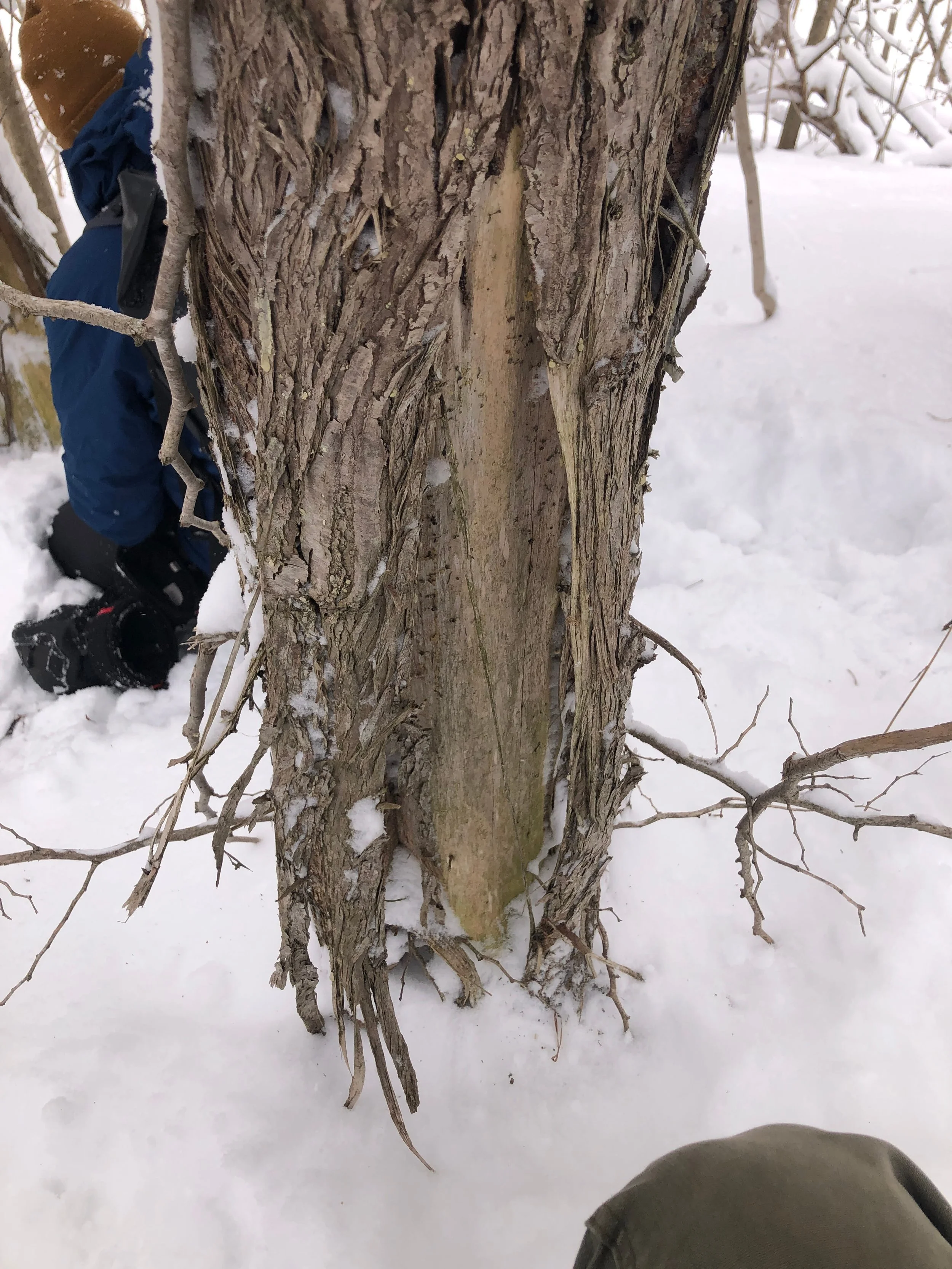
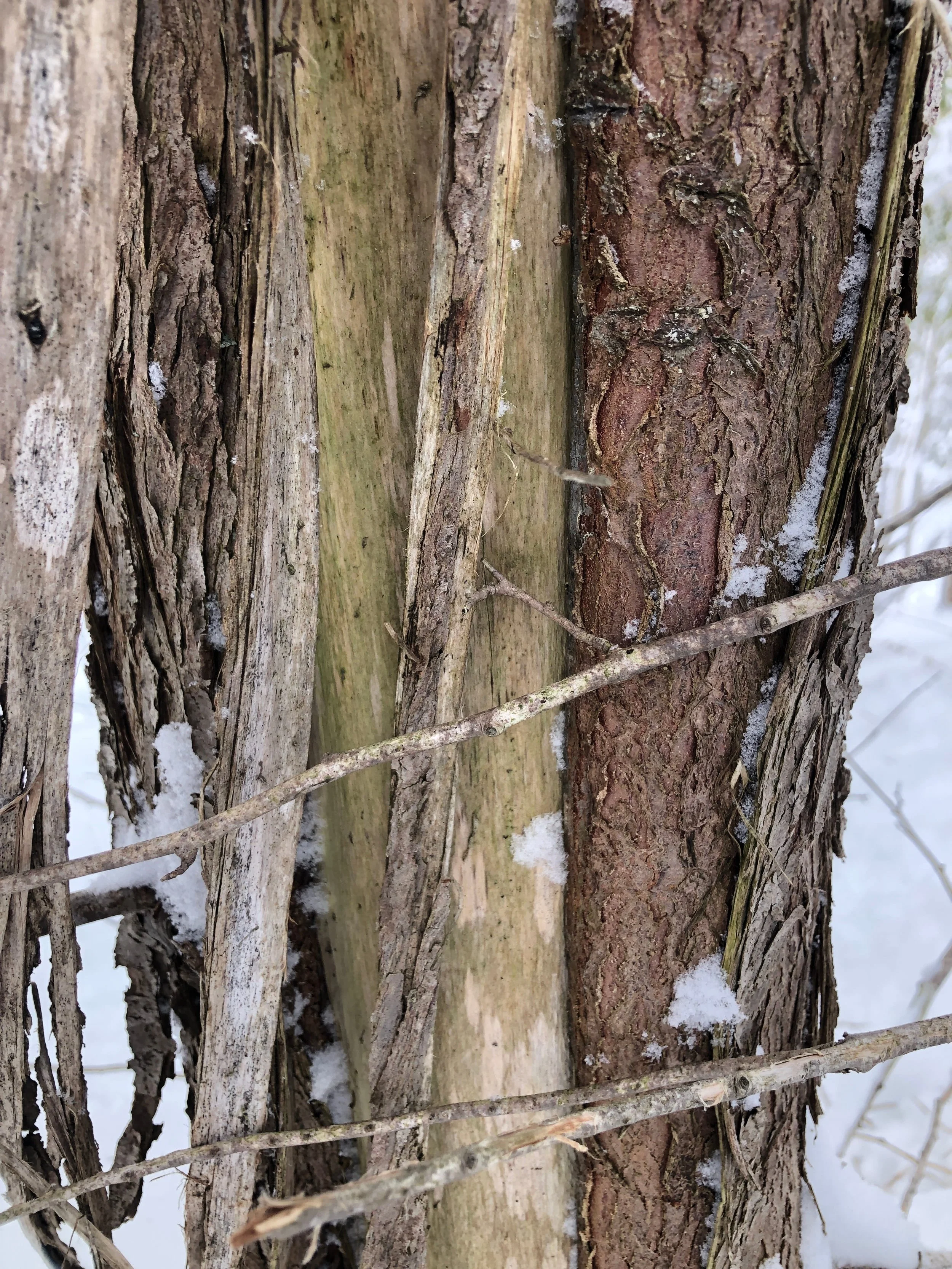
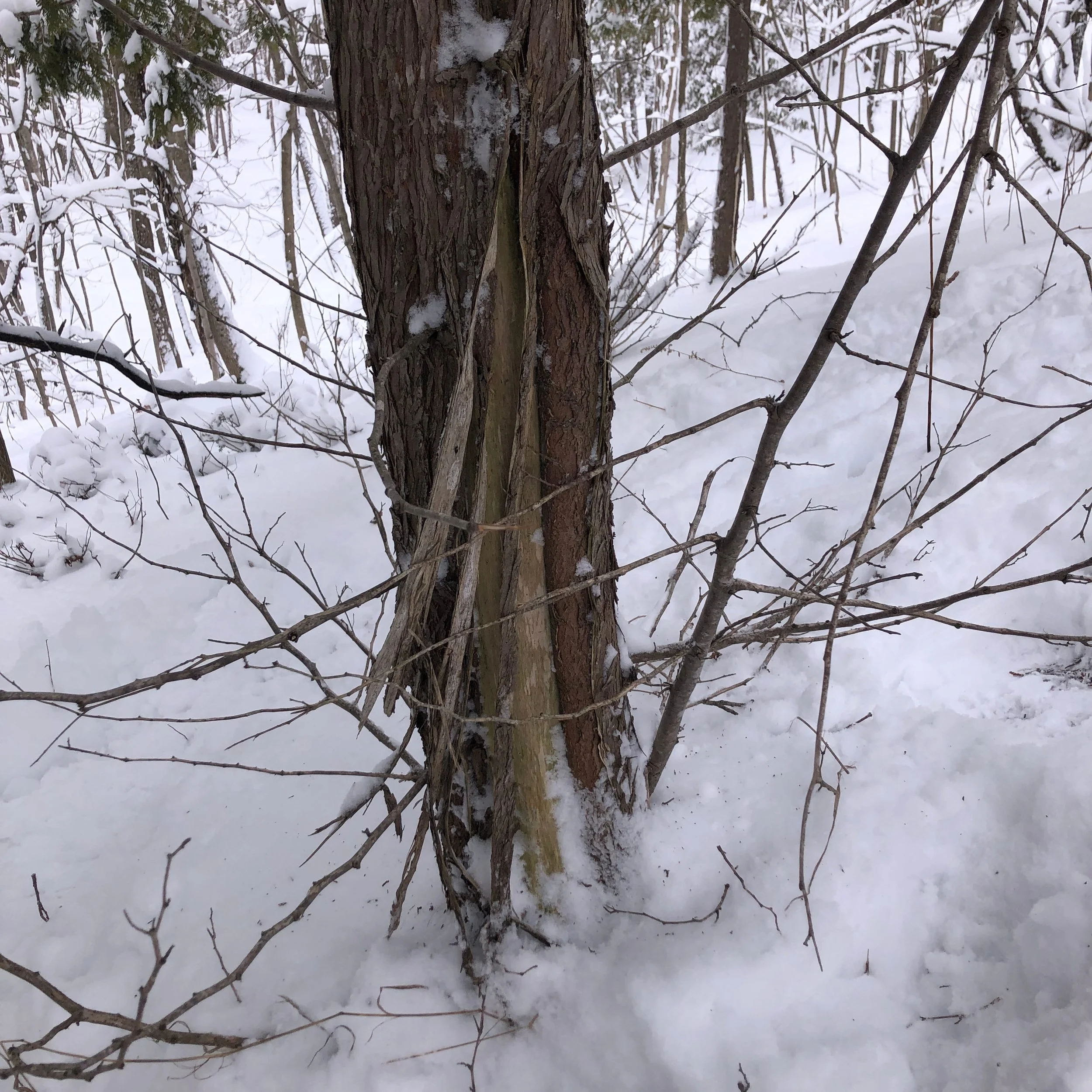
Similar sign on Buckthorn adjacent to Cedars.
At one spot there were at least five Eastern White Cedars which were all damaged in apparently similar ways. All of the wounds arose from the base of the Cedars where they were widest, and then rose up to a narrowed point at heights between 75 cm (nearly 30 in) , 80 cm (roughly 32 in) and 120 cm(almost 4 ft). Some of the wounds had long strips dangling from the sides, similar to what was seen in Parry Sound, and all appeared older than two years. Along the opened wound a couple had vertically oriented pale spots which some of the folks at the outing felt were indented into the wood. They were thinking that these could be the marks of the incisors from the possible bear which had made these signs. Adjacent to the Cedars, I also found a Common Buckthorn (Rhamnus cathartica) with similar exposed wood, free from cambium, looking about the same age, though without the dangling strips or the pale possible incisor marks.
Now, before moving on, I want to look into how this sign is described in the literature and then compare with what we saw.
In Mammal Tracks and Sign 2nded (Elbroch and McFarland, 2019) they write:
Black bears are also notorious eaters of tree cambium in the west and northwest of North America, where this behavior has become an intensive subject of both research and intervention to mitigate losses to tree farms. This sign varies depending upon tree species and the age of the sign. Fresh sign is often light in color, changing to red, purple, and orange as it ages, again depending upon the tree species. Bear sign on cambium may look like large patches of missing bark were chewed off on a western hemlock… or large strips of bark were peeled off when the tree is a western redcedar... Cambium feeding occurs when sap is flowing and the bark separates more easily from the sapwood; patches or strips are often removed all the way to the base of the tree, readily differentiating it from sign made by antlers. Teeth marks often become more apparent as the sign ages…, and extensive foraging often results in the death of the tree.
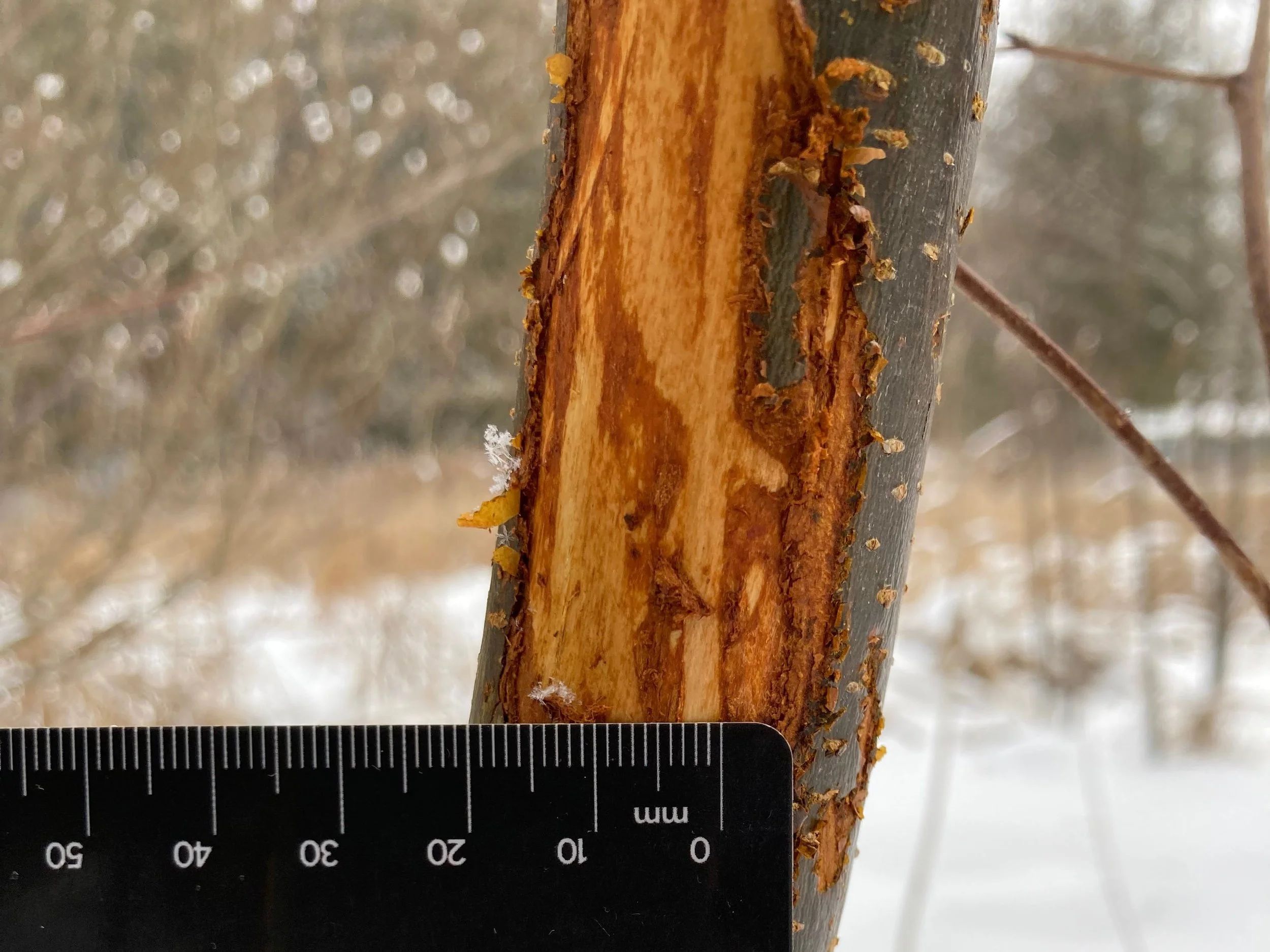
White-tailed Deer feeding on the cambium of Speckled Alder.
First thing I note in the description is that this behaviour happens out West. I believe it has only been recorded in the East once. This doesn’t mean that it doesn’t happen here though, just that it is more apparent, more researched and more widely understood out West. Secondly, about the teeth marks. I am unsure what we were seeing were teeth marks when compared with what I have seen online. The gouges I have seen in books and images online are longer, narrower and similar in appearance to ungulate incisor marks when they are seen feeding on bark and cambium. I also want to mention while White-tailed Deer cambium feeding is also pretty rare in Southern Ontario, yet this year I found some sign of this behaviour on Speckled Alder (Alnus incana) down close to Hamilton, Ontario. So there are no hard and fast rules about animal behaviour solely occurring in one region and not in another. I will also add that the characteristics of a sign will change and alter over time, and while I can see noticeable clear individual incisor marks when made fresh, we may loose some detail as the sign ages.
In the field guide Wildlife of the Pacific Northwest (Moskowitz, 2010), it says:
In many parts of our region, bears feed on the cambium of trees, including Douglas fir (sic), western Hemlock (Tsuga heterophylla), Western red Cedar (Thuja plicata), true firs (Abies spp.), and Black Cottonwood. They peel down the outer bark with their claws and scrape off the cambium with their lower incisors. In some forest, these signs are prolific yet often overlooked. Though this type of sign is visible year-round, this behaviour is most common in the spring.
This helps bring more context to the possible Black Bear cambium feeding, both in Parry Sound, and at the Noisy River, as they were both found on another Thuja species. Maybe Black Bears both near and far have a taste for Cedars?
The book with the most to say on Black Bears feeding on cambium seems to be Preston Taylor’s self published Tracking The American Black Bear (2021) which dedicates four long paragraphs to the phenomena, one of which details how the Black Bears actually access the cambium. Preston Taylor writes :
Bears claw at the bark to start the strip, grab a piece in their teeth, and pull the strip off the tree, sometimes more than 20 feet long… once the inner bark is exposed, they scrape it off the tree to eat. The feeding sign of bears on cambium presents itself in different ways based on the species and character of a tree. Easily stripped, young, smooth, growing trees, display, long, vertical grooves on the tree after the bear has fed. Trees with burls and sprouts, like Port-Orford cedar are too knobby for a bear to feed on the cambium in long grooves, so they take short – horizontal scrapes off the inner bark.
The pattern left on the tree is more a patchwork resembling porcupine feeding. The grooves in the tree’s wood, whether long or short, are from the bear’s incisor teeth.
I want to also keep this in mind for the future; Black Bear cambium feeding may appear differently based on the type of tree they are feeding on.
A final point he makes which I thought was interesting to note was that he believes that this cambium feeding behaviour is a learned behaviour. This could be a reason why we do not see it, or very rarely do, in the East as this feeding behaviour may not be as important a part of the Black Bear culture here, as it may be in the Western part of Turtle Island/North America.
In my research I also found a short video on youtube which shows a Black Bear demonstrating the cambium feeding behaviour:
Many Northeast tracking guides do not mention this cambium feeding sign from Black Bears as it may be uncommon in the Northeast. One publication by the US Forest Service (Nolte, D.L., K. Wagner, and A. Trent. 2003, linked below) named that this behavior and associated sign as occurring nationally, implying that it does occur in the Northeast, but perhaps it is just not as economically problematic, therefore, not researched or discussed?
I did find a single article, by accomplished Black Bear tracker Sue Morse, writing of her experience in Vermont in 1984. The article starts with this:
..I discovered some curious bear feeding sign on a mid-elevation ridgeline in northern Vermont. A pole-sized bigtooth aspen had been peeled to its roots like a banana. Strips of bark lay in tatters on the ground, and the exposed wood was scored with vertical groupings of parallel scrape marks caused by a black bear’s incisor teeth. Since then, I have observed this feeding behavior on balsam fir, young sugar maple, red pine, and red spruce.
Sue’s experience is pretty helpful in building the evidence.
Black Bear cambium feeding on Walnut in MA, USA. Photo by Bob Etzweiler. Thanks, Bob!
While there were some papers I found online which featured some research done in the Northeast, no peer-reviewed papers mentioned researchers observing Black Bear cambium feeding in the Northeast. But the researchers don’t always know what the trackers know (and vice versa). I personally reached out via email to some well-respected, and accomplished trackers in the Great Lakes Region, no one had observed Black Bear cambium feeding sign. But just East of the Great Lakes in the New England area, same region as Sue Morse, Bob Etzweiler did reply saying he has observed Black Bear cambium feeding sign “a small handful of times” in the Northeast, but he included that this sign is thought to be “not very common” in the area. This then implies that it does happen, just not too often. Which is also helpful and it seems like the anecdotal evidence is starting to build up. Bob mentioned that this is consensus with his tracking friends and colleagues. He also sent a photo of cambium feeding on a Walnut (Juglans sp., likely J. nigra) in Massachusetts, which was super cool to check out (shown on left).
Recently at work I took a small tour around our Eastern White Cedar forest to see if I could notice any sign that may look like what we saw up in Parry Sound or what we found at the Noisy River. I did come across a few Cedars which looked similar, but after closer inspection, I could easily see signs that would tell them apart; bare patches not reaching all of the way to the ground, or bark stripping not going higher than a metre. I did find a couple of trees which could fit the specifics of what we found, including what folks pointed out as aged and faded incisor marks. I took a few photos which I have included below.
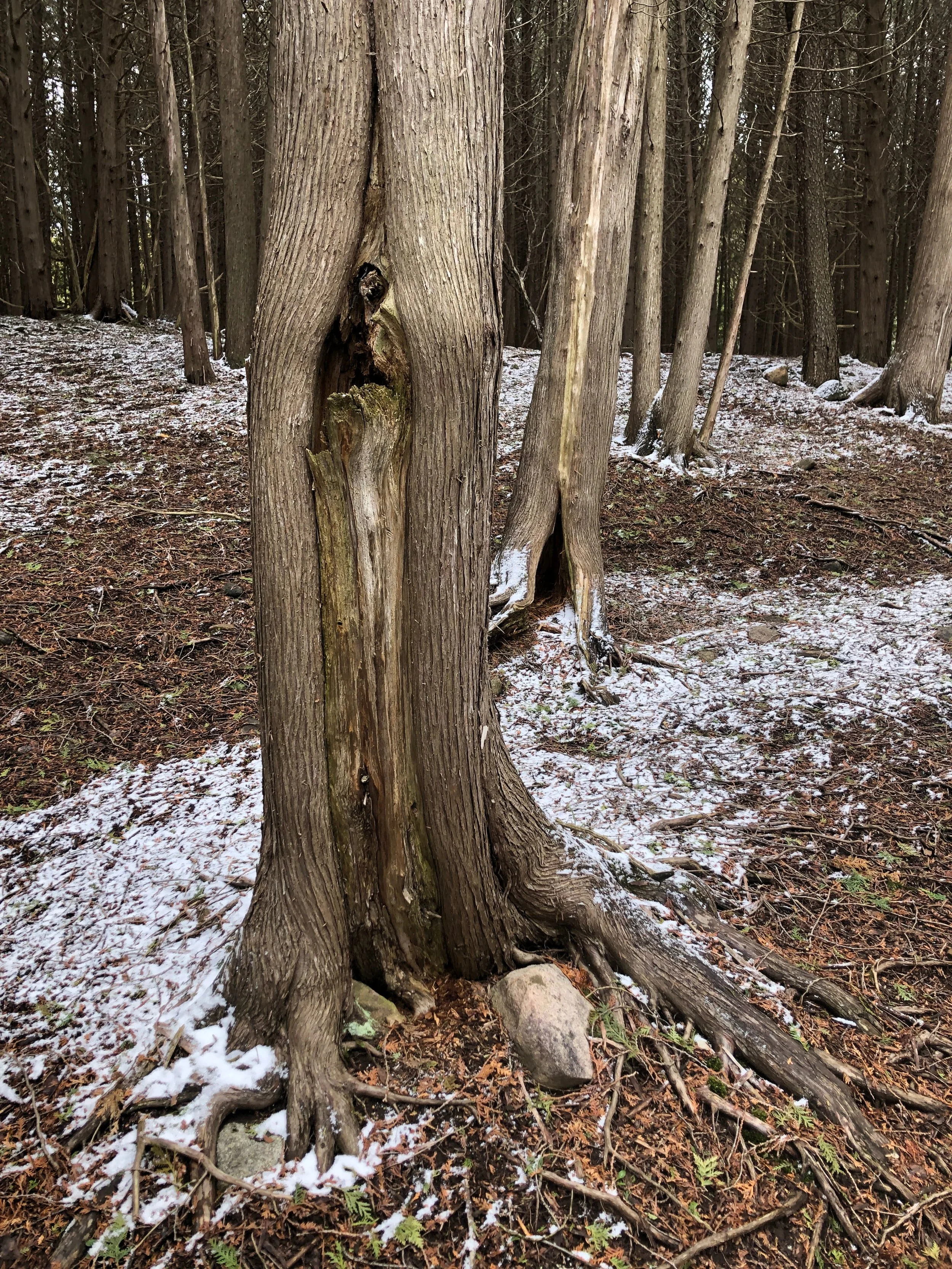
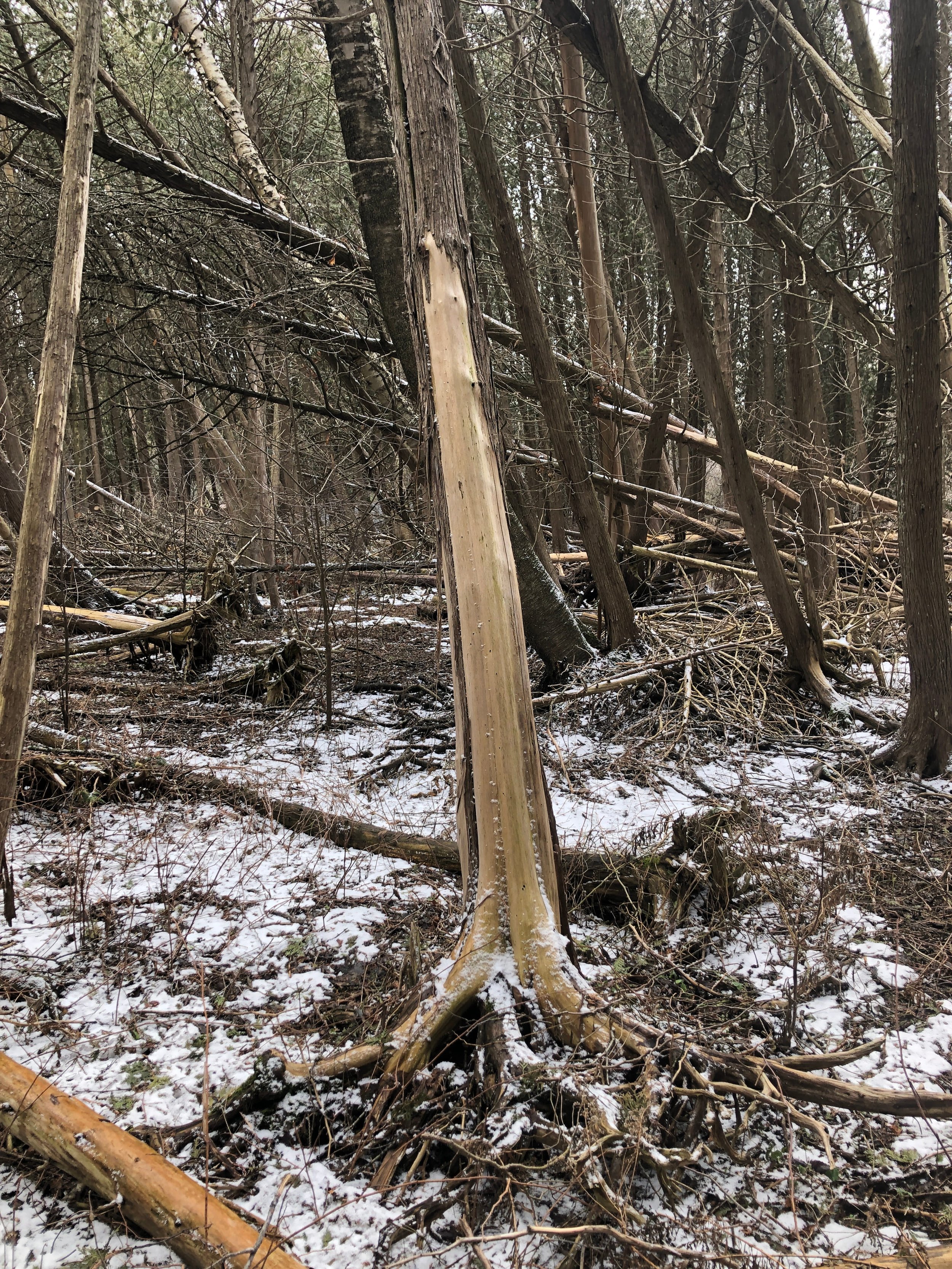
I believe that these are just trees which have survived some sort of damage and are either in the process of healing over, or have died, and the bark looks similar to that of Black Bear feeding sign. I do not believe they are sign of Black Bear feeding on cambium even though they look similar to what we found in Parry Sound and the Noisy River as we do not have any consistent population of Black Bears in Guelph and have not had any known Black Bears visitors in this part of Guelph for many decades.
My hope is to continue to look for Black Bear cambium feeding sign. This sign is similar to many other tracks and sign I have encountered in that I may have never seen it before, but once I do I start to see more commonly; I only begin to see the characteristics and slowly pick out the patterns. My hope is that this process of research and reflection help to tease out some details which I might miss, while also leveraging any doubt and uncertainty towards being a better tracker. While I may sometimes wonder at whether a sign is what others point out or not, I would rather do the research and be on the look out, rather than to ignorantly dig my heels in on a stance that I honestly don’t know that much about.
I am grateful to the bears for leaving sign to cofound, confuse and encourage me to keep learning. To my tracking colleagues at Earth Tracks, to TCNA evaluators like Sage Raymond who show me things I have never seen before, and to all those who help me along this path.
To learn more :
Timber Damage by Black Bears: Approaches to Control the Problem. Nolte, D.L., K. Wagner, and A. Trent. 2003. US Dept. of Agriculture, Forest Service. (pdf)
Mammal Tracks and Sign, 2nd ed. by Mark Elbroch and Casey McFarland. Stackpole Books, 2019.
Wildlife of the Pacific Northwest by David Moskowitz. Timber Press, 2010.
Tracking Tips: The Ap-peel of Cambium by Sue Morse
Peterson Reference Guide to the Behavior of North American Mammals by Mark Elbroch and Kurt Rinehart. Houghton Mifflin Harcourt, 2011.
Natural History of Canadian Mammals by Donna Naughton. Canadian Museum of Nature and University of Toronto Press, 2012.