Subcuticular Mine in White Pine
Recently I participated in an fundraiser auction for farmers, lands stewards and land defenders in Gaza, Sudan, the Congo, Atikamekw Territory and Southern Lebanon. It was called Solidarity is our Strength. One of the organizers is a friend and reached out to ask if I would like to contribute to the auction, and I immediately wrote back that I would love to ‘donate’ a private four hour wildlife tracking workshop. For events like this, they usually cost about 400$ range, depending on who is asking and what they can afford. I wasn’t sure who would be interested, but I figured the organizers can post it and if it didn’t make anything, whatever. If it made anything, that would be great. Turns out a few people bid on it and it was a successful lot and contributed to the overall sum the auction raised. Awesome.
Fast forward a couple of months and last Saturday I got to go out with a small crew and share some knowledge on track and sign. We saw some common species throughout the day and it was fun and exciting, but as we were walking through a White Pine (Pinus strobus) plantation I noticed a small pale brown line on the tree just about 170 cm (roughly 5.5 ft) up on the trunk.
I stopped the group and I asked if we could investigate what this was because I had no idea. I like when that happens; when you are the teacher/facilitator and you can come across a mystery when you are with those you are supposed to be teaching. It demonstrates that we are all learning and growing together.
The strange squiggly line was a pale orangey-brown set against the young, green, gastropod grazed, lenticel covered bark of the White Pine. The riverine line meandered with no clear path or restriction - it just wiggled along it’s way. At the end of the line there were wider broad sections where the bark appeared to be broken or depressed.
It looked similar to a linear leaf mine, but this was in, or perhaps under, the bark. I was stoked.
We pulled out Tracks and Sign of Insects (Eiseman and Charney, 2010) and I quickly began thumbing through looking for photos or the chapter on sign found on twigs, stems and stemlike structures, I flipped a page and found a photo which looked very similar. The photo was of a similar tiny erratic ridge making its way around an Ash (Fraxinus spp.). The heading was Subcuticular Mines.
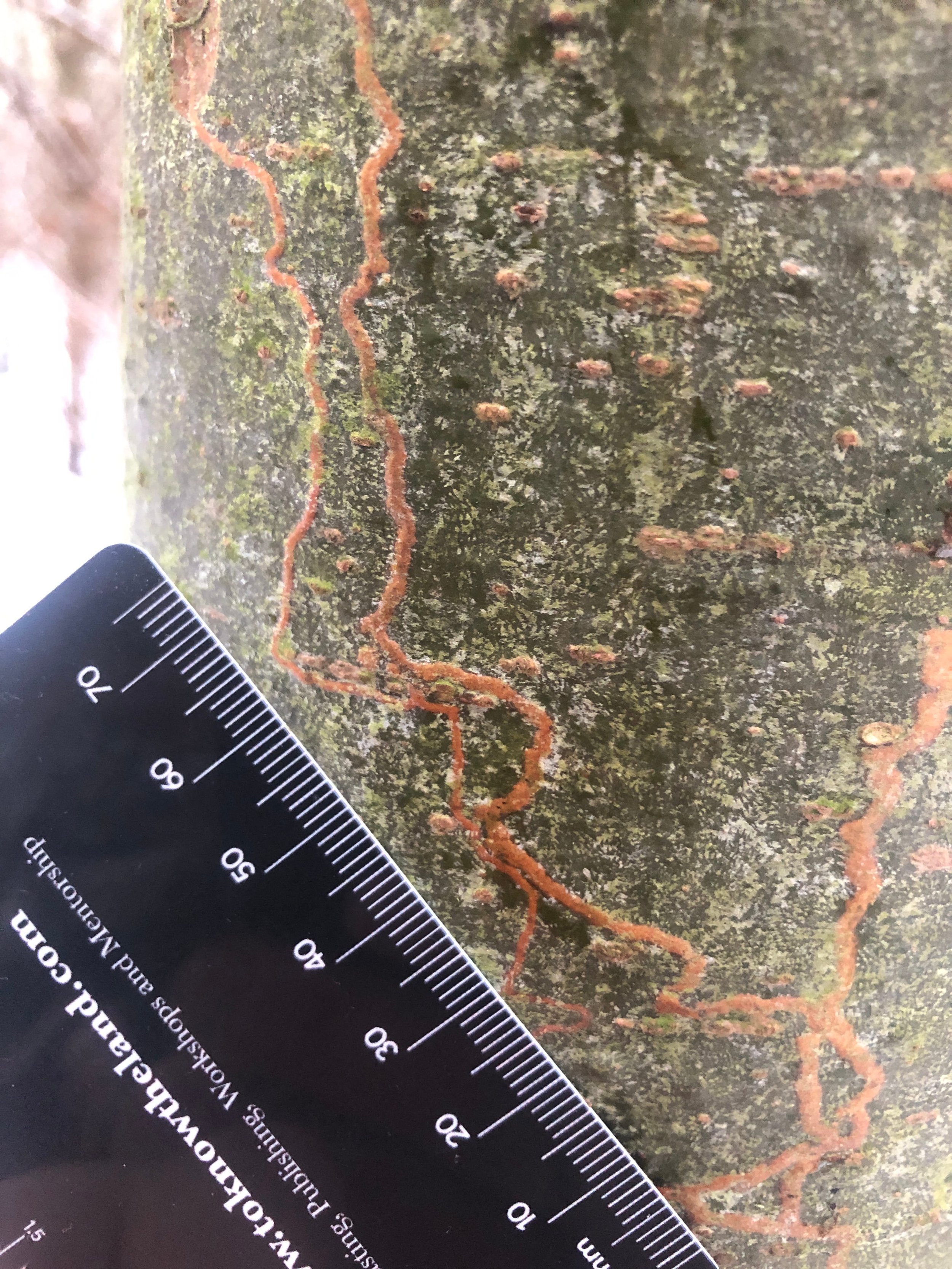
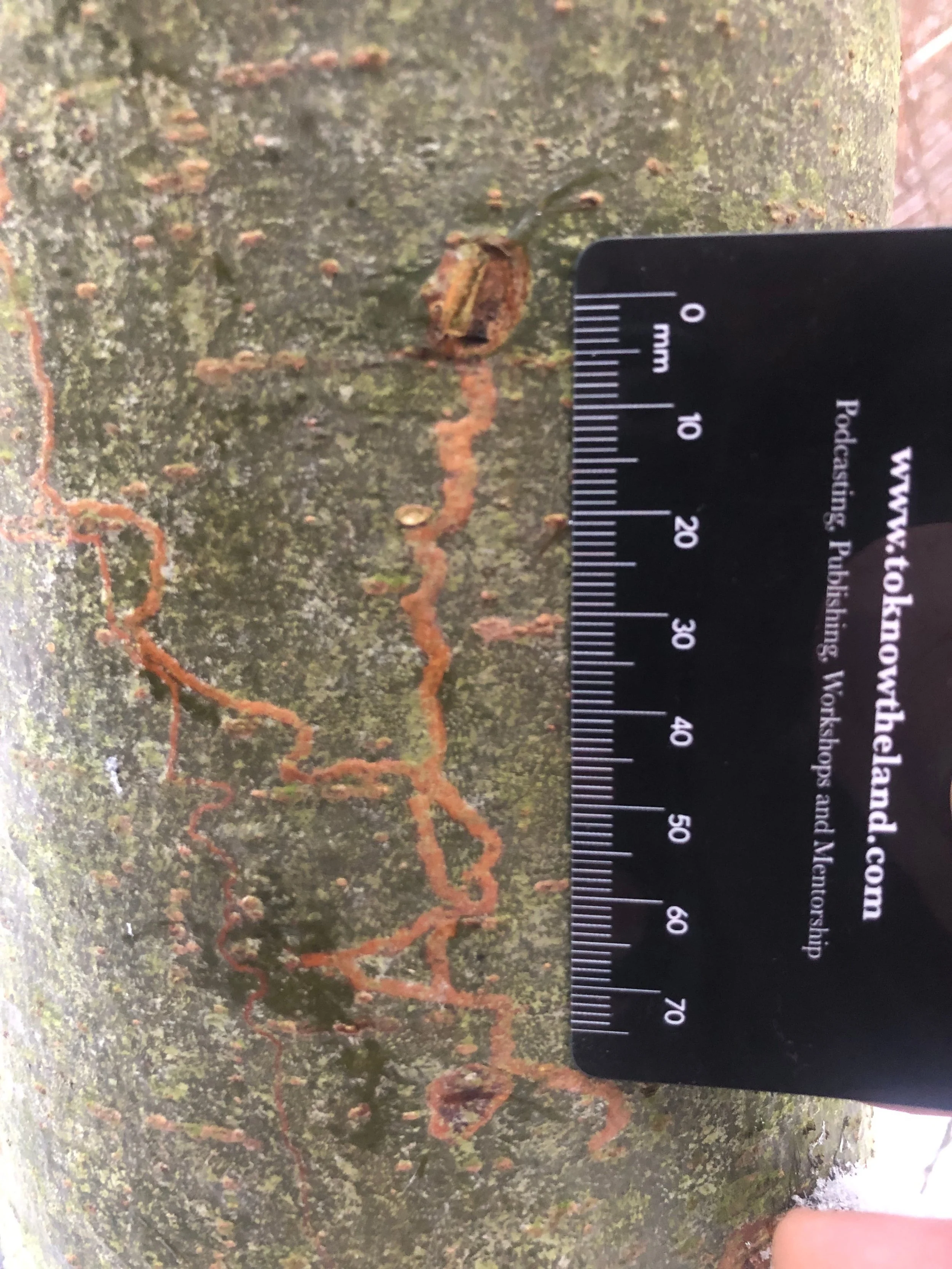
Sub- is a Latin prefix meaning below, under, or beneath, and cuticular comes from the Latin cuticula, which translates to skin. Sub-cuticular would then translate to “under skin”, which makes a lot of sense for this sign. It appears to be under the bark, or “skin” of the tree. As we read on the entry described these ridges as mines very similar to the related leaf mines. They were created by a moth larva from the Marmara genus, likely Marmara fasciella who feeds on White Pine and Balsam Fir (Abies balsamea).
Who are these Marmara moths? From what I am learning, all of the Marmara moths leave similar track lines in forbs, fruits and woody plants, like this pine we found the trail on. I have seen images of Sweet Oranges (Citrus × sinensis) with Marmara attributed mines running along the skin.
Marmara may come from the Greek word marmaron or marmaros, which means something like shiny stone or “marble”. This may be to do with the shiny marbling pattern on the wings of the adult moths. Fasciella translates to “little band” or “little stripe”, also possibly pointing to the lines on the wings, or maybe it points to the thin mines which stripe the White Pine bark? I have also read a common name, the “White Pine Barkminer”, which I think suits the species well.
M. fasciella particularly, makes their cocoon under a loosened flap of bark. Something cool I read about was that other Marmara moths may ornament their cocoons with fancy looking white poofy bubbles made in their butts and pushed out to decorate their cocoons. M. fasciella does not do this behaviour, but it is something to look for to identify other species.
The adults emerge at the end of May until early July, then they mate, and the female lays her eggs on the bark of the White Pine. The eggs hatch from the bottom, where the newly eclosed larva then chew and crawl their way into the phloem layer to start feeding and travelling, thus creating the mine in their wake. They eat and mine until late Summer and Fall and then hibernate until the early Spring the following year.
It is assumed that M. fasciella range matches the range of White Pine, but they have also been found on Balsam Fir, whose range extends further West and further North than the White Pine. While both White Pine and Balsam Fir ranges both do not naturally stretch to British Columbia, M. fasciella has been found on a Western White Pine (Pinus monticola) out there, so perhaps this is another species they are likely to be found inhabiting and feeding on.
I often repeat a quote I heard somewhere about how for every insect, there is probably a wasp species that parasitizes them. It seems for Marmara fasciella is not immune to this tendency. According to one note I read from 1943 (linked below), they are parasitized by Copidosoma sp., Habrocytus sp., Hemiteles tenellus, Pleurotropis sp., Pleurotropis sp. (probably lithocolletidis), and Elachertus sp.!
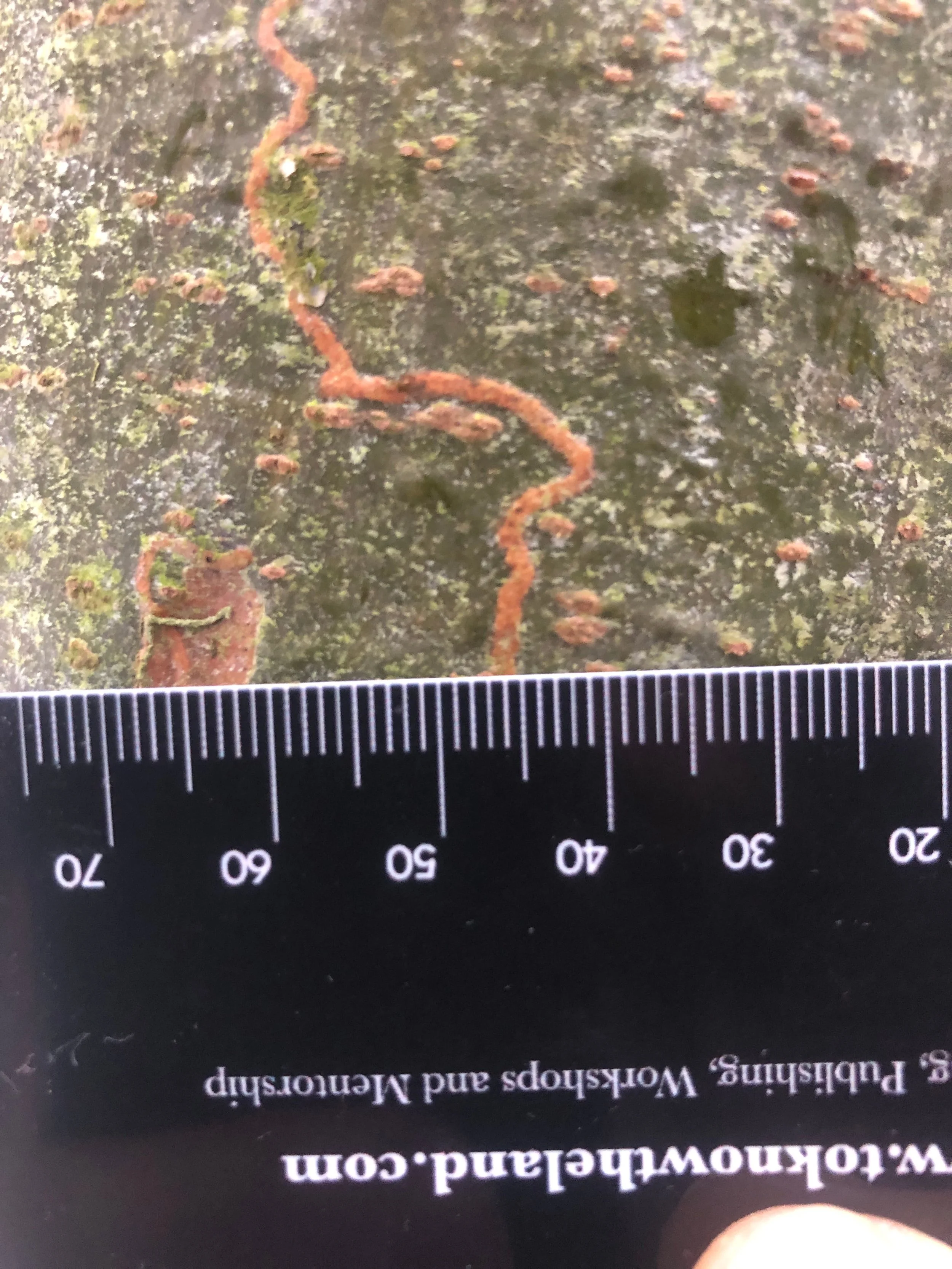
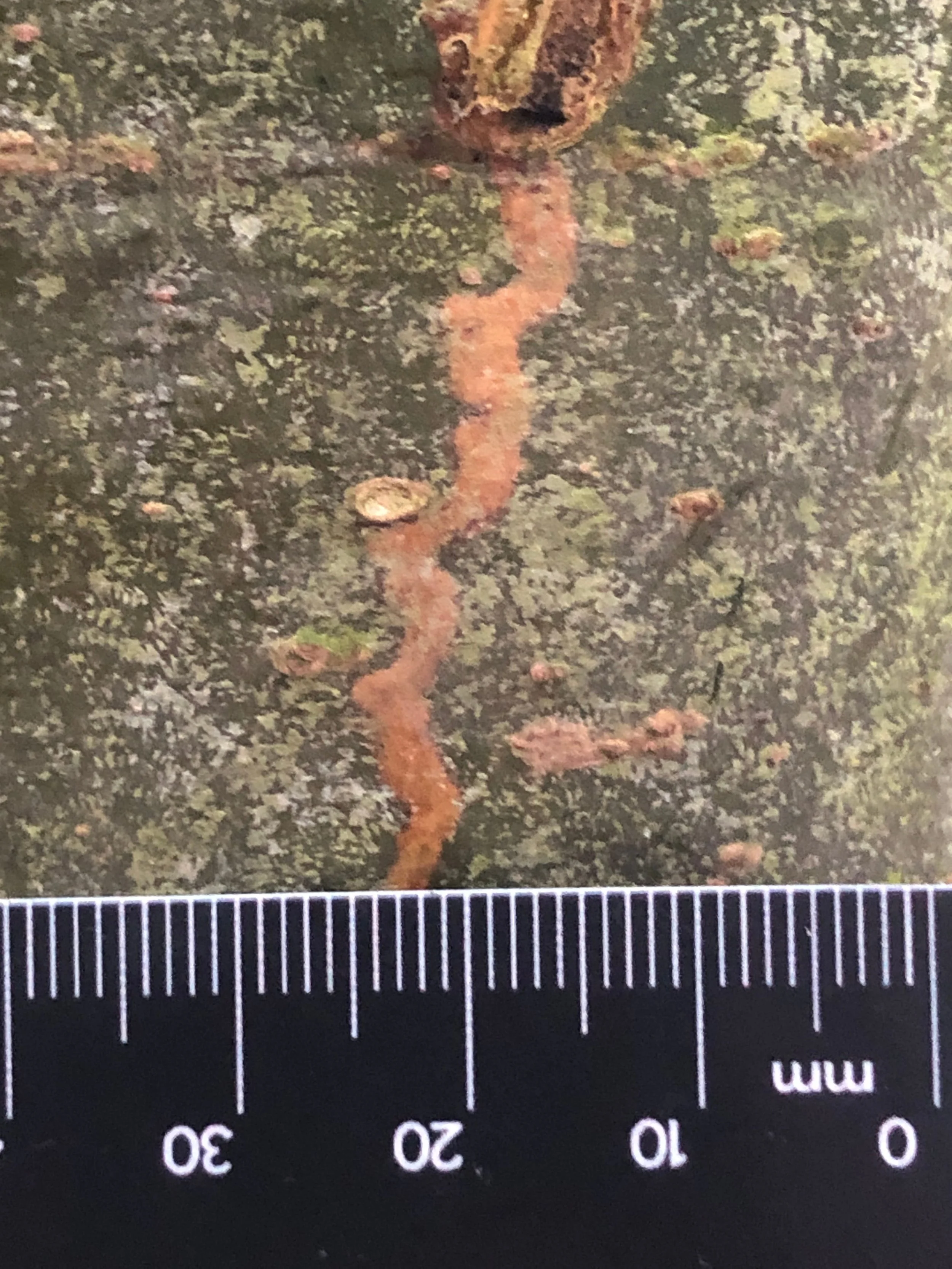
There isn’t a lot of information on the internet which I can find about M. fasciella, and I still have a lot of questions about the sign in particular. Is there a way to age these mines? Do the older ones appear longer or darker than the newer ones? Are there any interactions between the moth mining below the bark and the gastropods feeding on the algae on the outer surface of the bark? What are the indentations along the mines? Are these cocoon sites, entry sites or emergence sites? Is that where the parasitoids gain entry? Do the wasps wait outside the cocoon sites waiting for the emergence like wolves waiting outside a beaver lodge?
I think all of my questions point to one thing; I must take more time observing these mines throughout the year and see what happens as the seasons change. Will I see the adults emerge? The females laying their eggs? Will I witness the wasps closing in?
I feel its just like the land to say “slow down, wait, watch,” and I guess that’s just what I’ll do.
To learn more :
Tracks and Sign of Insects and Other Invertebrates by Charley Eiseman and Noah Charney. Stackpole Books, 2010.
Microleps.org entry on the Marmara genus.
INSECTS OF EASTERN FORESTS U.S. Department of Agriculture Forest Service, 1985 (pdf)
NOTE ON MARMARA FASCIELLA CHAMBERS by J. J. de Gryse. The Canadian Entomologist, 1943