Sapwood Timberworm Beetle : A mystery solved.. finally!
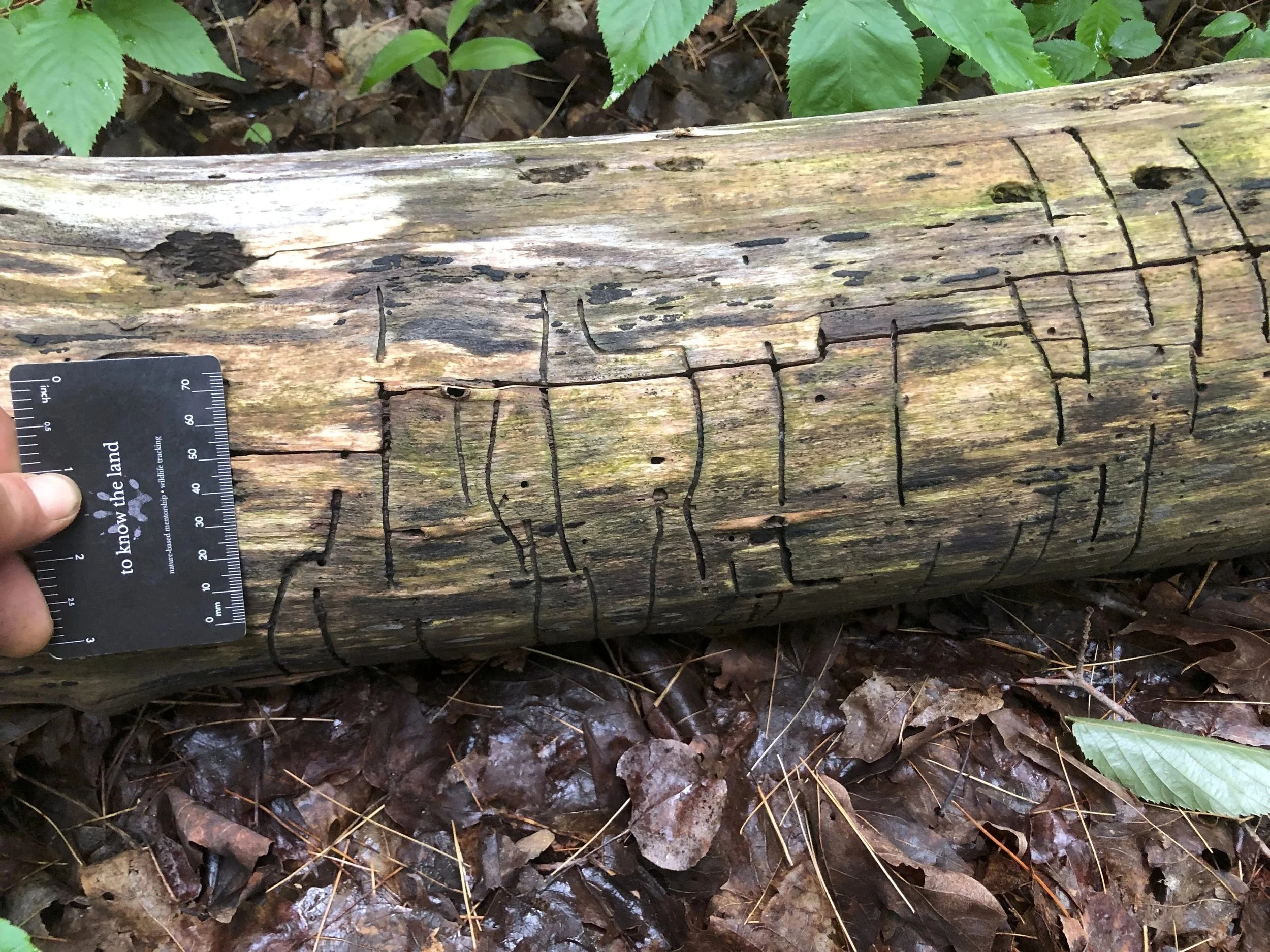
It has been years that I have been finding dead logs in the woods with cryptic lines etched into the outer bark, followed by a final exclamatory dot. Who, or what, was making these marks in the wood? I have wondered at this mystery for years. A tracking mystery which truly put “the quest back in question, and the search back into research!”
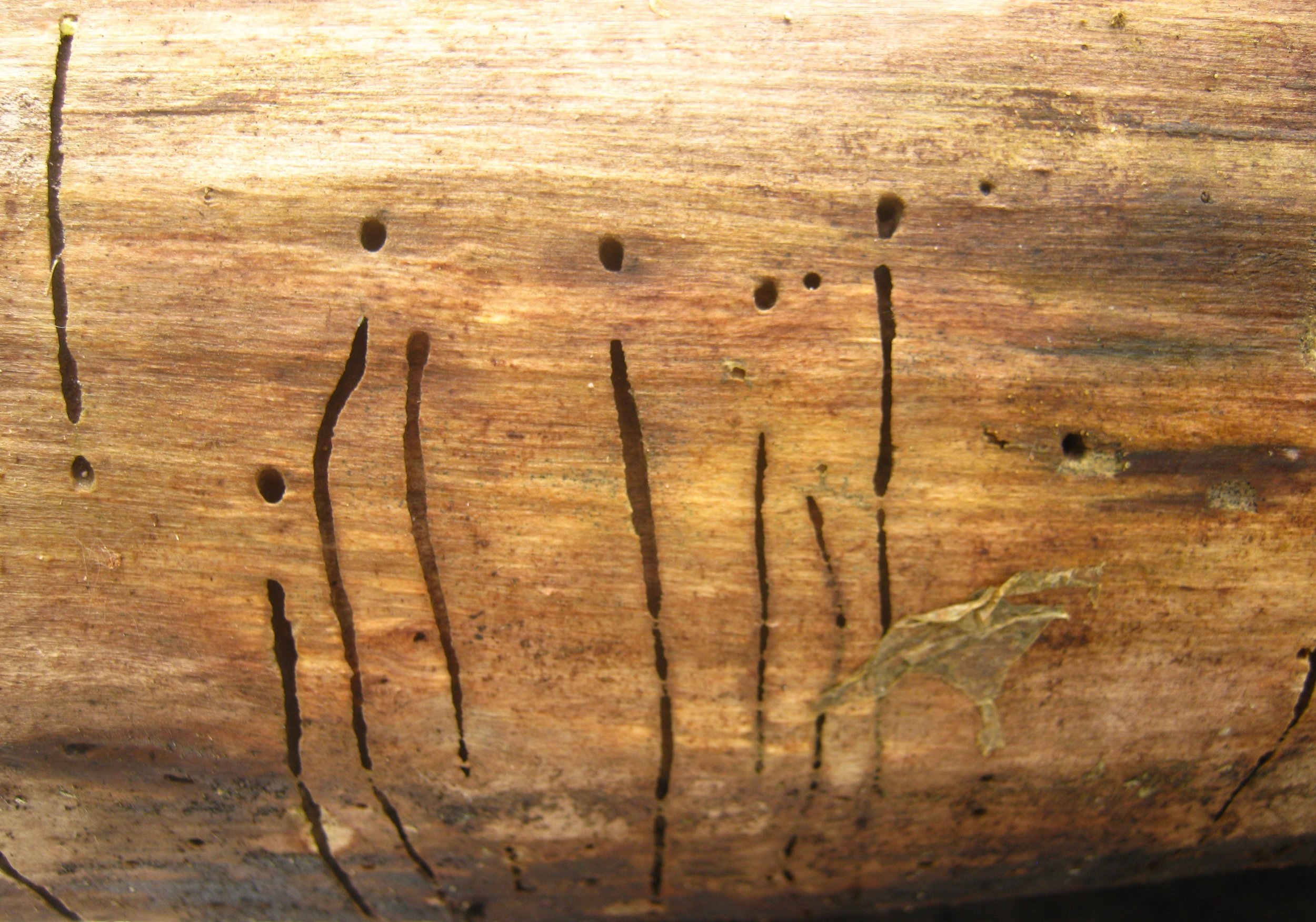
Photo taken sometime before February, 2021. Can’t remember the location.
Again while out with the Earth Tracks Wildlife Tracking Apprenticeship, we found these beautiful signatures from some unknown signatory writ long in the wood. It seems that everywhere and every time I go into the woods my eyes scan for tracks, for bones, for plants I knew or wildlife moving across the landscape, and almost inevitably I would encounter this sign again, written in the dead standing snags and fallen logs littering the forest. Most of the time the trees were missing most of their bark and I had a lot of trouble identifying to species. I did notice that most of those I could identify were Poplars of some kind, but the branches were either too high, to worn or just absent and I couldn’t look to bud shape or twig form to better i.d. who I was looking at.
I figured that these marks were made by an invert, likely an insect, most likely a beetle (I hear one in five animal species on Earth is a beetle, so I had good odds), but I couldn’t find any images anywhere in my library to lead me to a name or genera with any certainty. The long lines appeared like galleries of other beetles I have seen and the way they infested the trees outer sapwood so thoroughly.. I just figured it had to be an insect, but I still had my doubts at first. Could it be some fungus that only grows in certain patterns? What about some other invert? Some mysterious arachnid that bores into wood? Doubted it. So I kept searching my books and asking folks I knew for help, but all to no avail.
I had asked many strangers and friends on naturalist and forestry related outings. I had reviewed all of my forest pest related pamphlets and turned page after page in my pretty substantial library. I had gone to the University of Guelph library to search the stacks, but still, no answers. Finally I turned to the internet in hopes of finding some leads. The /r/whatsthisbug subreddit had failed to answer my questions, and I still couldn’t figure out how to navigate bugguide.net. I was lost in a vast wilderness of obscure scientific names to species I wasn’t quite sure lived in my region and it was all very overwhelming.
Finally, on April 5, 2026 I posted an image of one of these fallen trees with the potential beetle galleries on INaturalist, and selected “Beetles” as the species name, again, just taking a chance in hopes that it might lead someone more knowledgeable than I am to see the photo and help me get a little bit closer to the right identification. It was a long shot, but I was hoping that someone could help.
A day or two later, along came the user “borisb” who suggested the i.d. of “Sapwood Timberworm Beetle” aka Hylecoetus lugubris.
When I saw this i.d. I immediately looked at any photos on Inat I could find of the galleries, just to be certain that this faraway internet beetle nerd (I say nerd in the kindest, respectful way) from Berlin was correct, and Damn! He was! There were a few other photos of the galleries on Inat, and I was just thrilled. This was very exciting to me. At least five years of wondering and looking but now I had a name, which meant this was the start of a new phase in my learning process.
In light of this discovery and finding their galleries again with the tracking apprenticeship folks, I wanted to write a blog post sharing what I am learning about these little beetles so others can learn about them as well.
2026.07.04 Side rd 6, north of Durham
Sapwood Timberworm Beetle (Elateroides lugubris formally Hylecoetus lugubris)
Coleoptera: Lymexyloidea: Lymexylidae: Elatoroides lugubris
The scientific name Lugubris is from the Latin lūgubris, meaning of or, for mourning, or to be in mourning. Some folks suggest that this could be related to the colours of the beetle, but it could also be the mourning of the wood workers and millers who might come to find the exterior wood of a new sawn log unusable due to the galleries created by the larvae of the beetle.
(I am going to start by saying about half of the information I could find is from research done on a very closely related species found in Europe, Elateroides dermestoides. Same genus, different species. I am doing this because there isn’t a lot of research out there on our native species so I need to broaden the scope a little. It is assumed that there is a lot of overlap in life cycle and habits between the two species and therefore the information I have included here still seems relevant.)
I have read that the adults of the species are very rarely encountered in the short period of time over a few days in Spring, and when encountered that the males and females can be identified by differently shaped antennae and maxillary palps. I then had to ask, what is a maxillary palp and what do they look like? My research tells me that maxillary palps are segmented, antenna-like sensory appendages attached to the maxillae (which are the paired, food-handling jaws) of insects and some other arthropods. They act as sensory outposts, used to smell, taste, and touch food and to detect environmental cues before the insect ingests something. Pretty cool. But aside from eating, the short adult life of a Timberworm Beetle consists of mating, ovipositing, and then there seem to be no more recorded behaviours.
As was mentioned above, they are commonly found on Poplar species, but can also be found on Birch (Betula spp.), Basswood (Tilia spp.), Black Walnut (Juglans nigra), or Tulip Tree (Liriodendron tulipifera), usually when the tree is on it’s way out, and when the wood is moist to some degree, which may facilitate a cool habit of the species in the genera.
All Sapwood Timberworms are Ambrosia Beetles, which as a group may have evolved around 200 million years ago. These beetles have specific relationships with ascomycetous yeasts, a kind of fungi of the genus Alloascoidea. This affinity shows up in a very cool way. When the mother Sapwood Timberworm beetle lands on the bark of a diseased or decaying hardwood tree from April to July, she extends her telescopic ovipositor and pierces the wood. She then lays an egg which is coated with spores from the associated fungi. These spores are stored in the mothers body in a “pouch” called the mycetangia. The mothers ovipositor is retracted inside her body when not in use, but when it is in use, the ovipositor protracts, the spores are picked up by the egg, and finally, the spore smeared eggs are laid into the wood.
Once the larva hatches they wriggle about collecting the spores which have coated the egg. The larvae then chew their way through the wood creating tunnels, and as they do this, the fungal spores which now cover their bodies drop off of the larval beetle, cling to the walls of the tunnels created and there the spore germinates and starts to colonize the wood surrounding the larva.
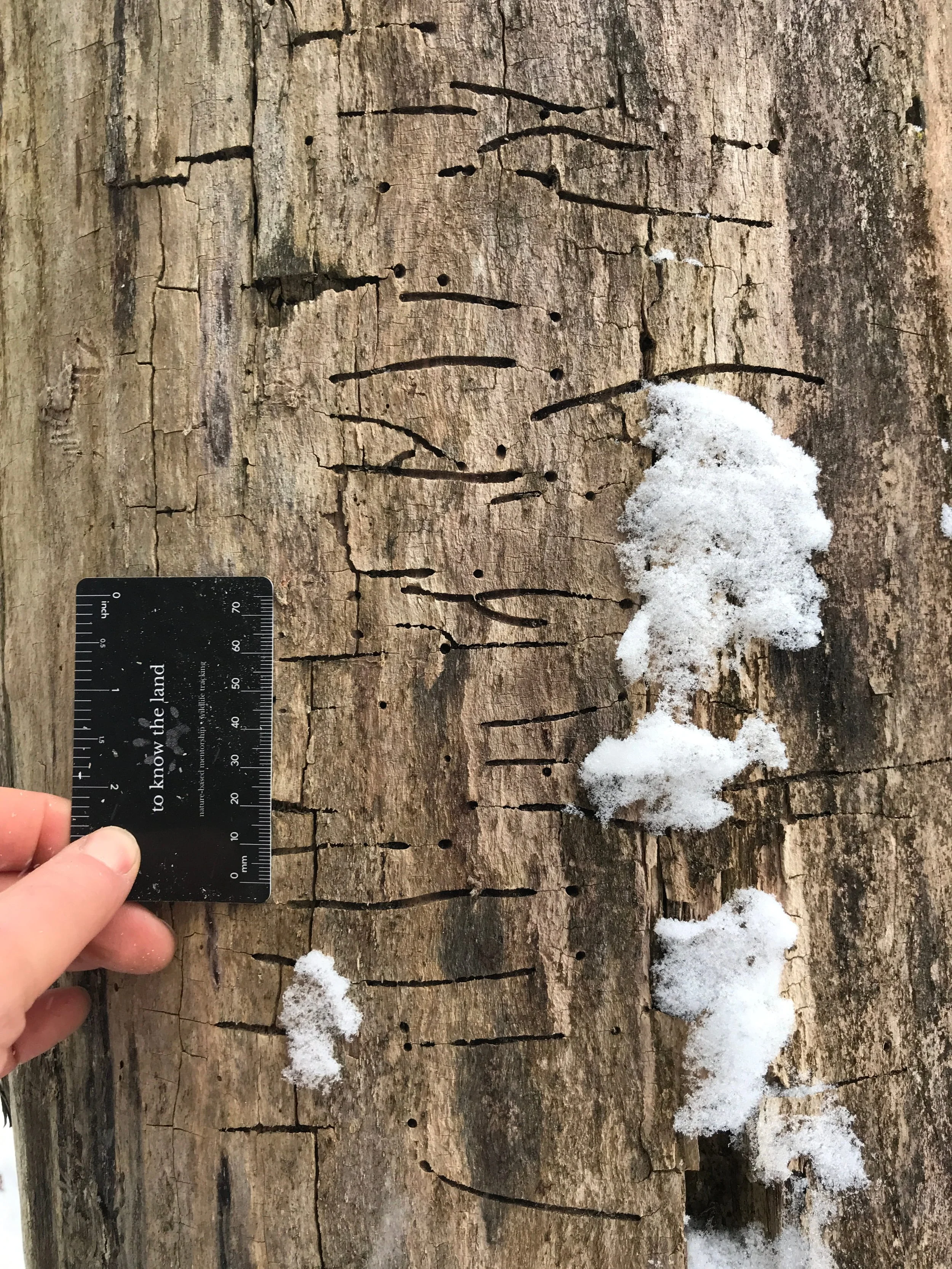
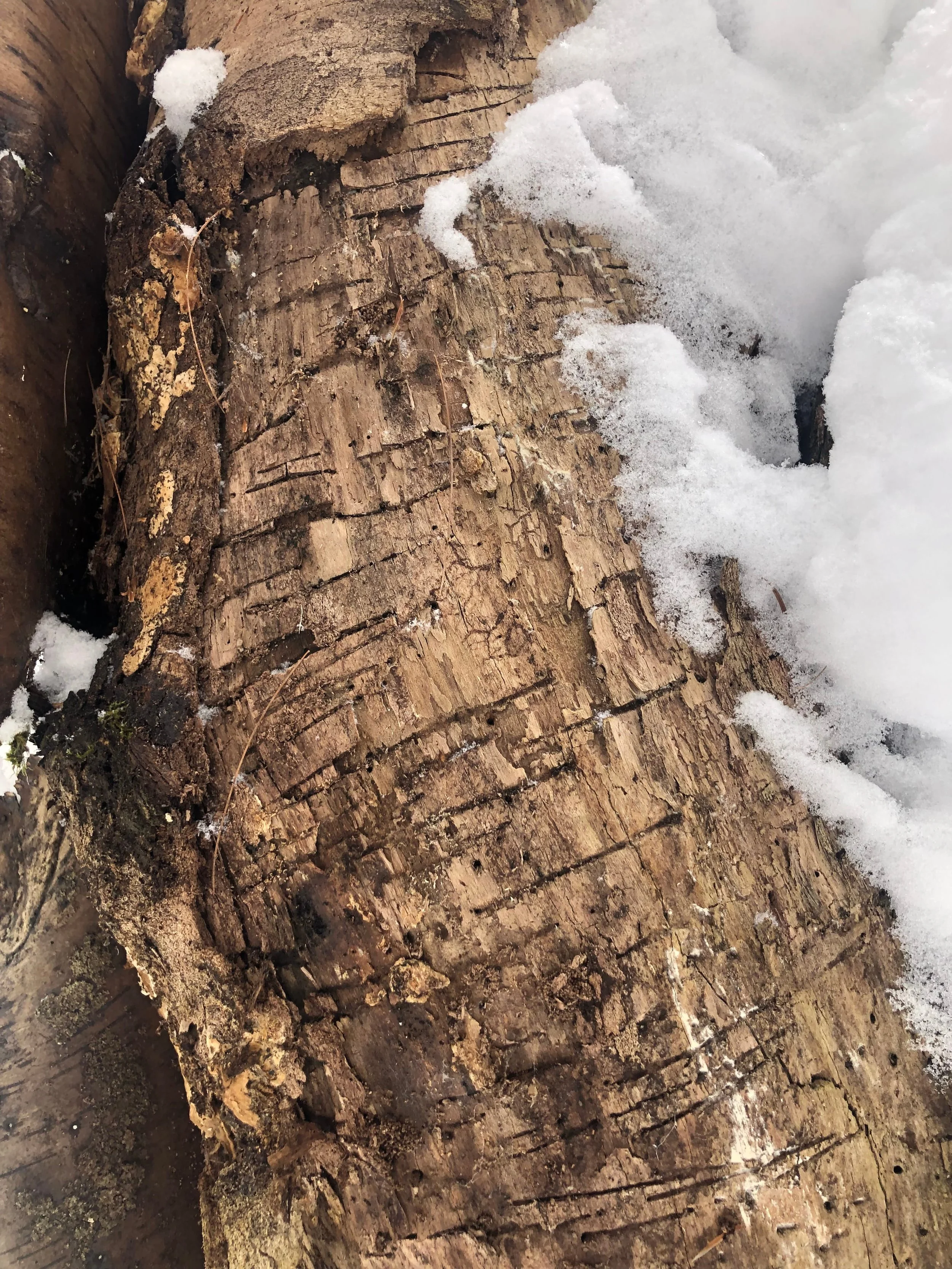
The as the fungi spread, the larvae begin consuming the yeasty fungi which is growing in the moist tunnels in the sapwood or floem section of the wood. The Timberworm larva tunnels their way through the wood creating long narrow galleries just within the surface of the wood, as seen in the images above. Some folks at the apprenticeship outing said they could tell where the entry hole was and where the emergence hole was, but I don’t know if I can tell yet. Was it the beginning of the long line or was it the smaller hole, the dot of the exclamation mark (!)? From what I can gather from information online, the point hole, the little dot, is the entry hole.
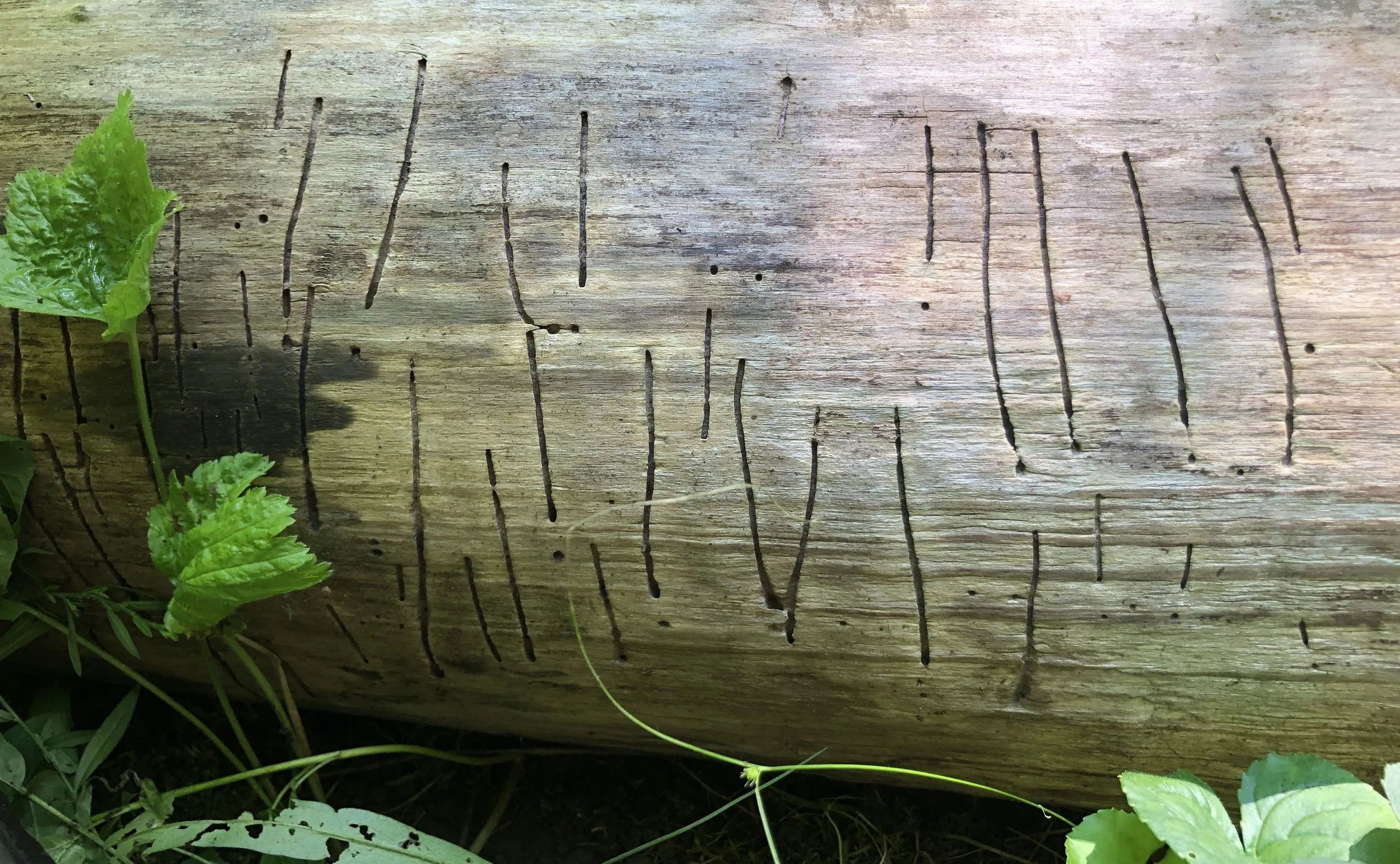
2026.07.14 Sapwood Timberworm Beetle galleries @ University of Guelph Arboretum by beaver pond
I have yet to find a single larva of the Timberworm, but I have read that the larvae have a distinguishing feature; a conical, slender, barbed spine on the ninth segment of their long, maggot like bodies. I’ll be looking for this.
Sapwood Timberworm Beetles are part of a group of species known as ship-timber beetles. They are so called because back in the day when millers were harvesting wooden timbers for ships the larval galleries were often encountered. Now most wood is harvested for lumber. Maybe they may end up being called a Lumberworm Beetle?
In North America there are two species of ship-timber beetles, E. lugubris and Melittomma sericeum, also known as the Chestnut Timberworm, who primarily feed within Chestnut (Castanea dentata), Elm (Ulmus spp.) and Oak (Quercus spp). I have yet to find signs of this species, but I am on the lookout. I hope that there is a slight variation in the galleries, but I’ll only know when I see them. The family these two species are in includes some 70 species worldwide, and is the sole family member of superfamily Lymexyloidea.
I am now on the lookout for larvae and adults, which I may not find until next Spring, but until then the galleries will suffice. I am also thinking of getting a new tattoo of the galleries on my leg, but we’ll see if that comes to pass. Maybe, maybe not. I like to hold on to the idea a little while before deciding to get it done. Before being permanently etched into my skin, I want to get to know how it might look and carry the design in my mind and heart with me for a bit. But I also know that I have had this simple yet mesmerizing beetle gallery etched in my mind for many years now, the mystery tattooed in one of the small secret chambers my heart reserved for unknown tracks and signs. I don’t know if I would mind too much having it written on my body either.
To learn more :
Original INat observation which enabled the research
The evolution of fungus farming in ship-timber beetles (Coleoptera: Lymexyloidea) by Lennart J. J. van de Peppel, Veit Grabe, Maximilian Lehenberger, Frank F. M. Becker, Gerrit Holighaus, Peter H. W. Biedermann.
Extraordinary Animals : an encyclopedia of curious and unusual animals by Ross Piper. Greenwood Press, 2007
Insects of Eastern Forests by US Department of Agriculture Forest Service, 1985. (pdf)