I Found A Carpometacarpus
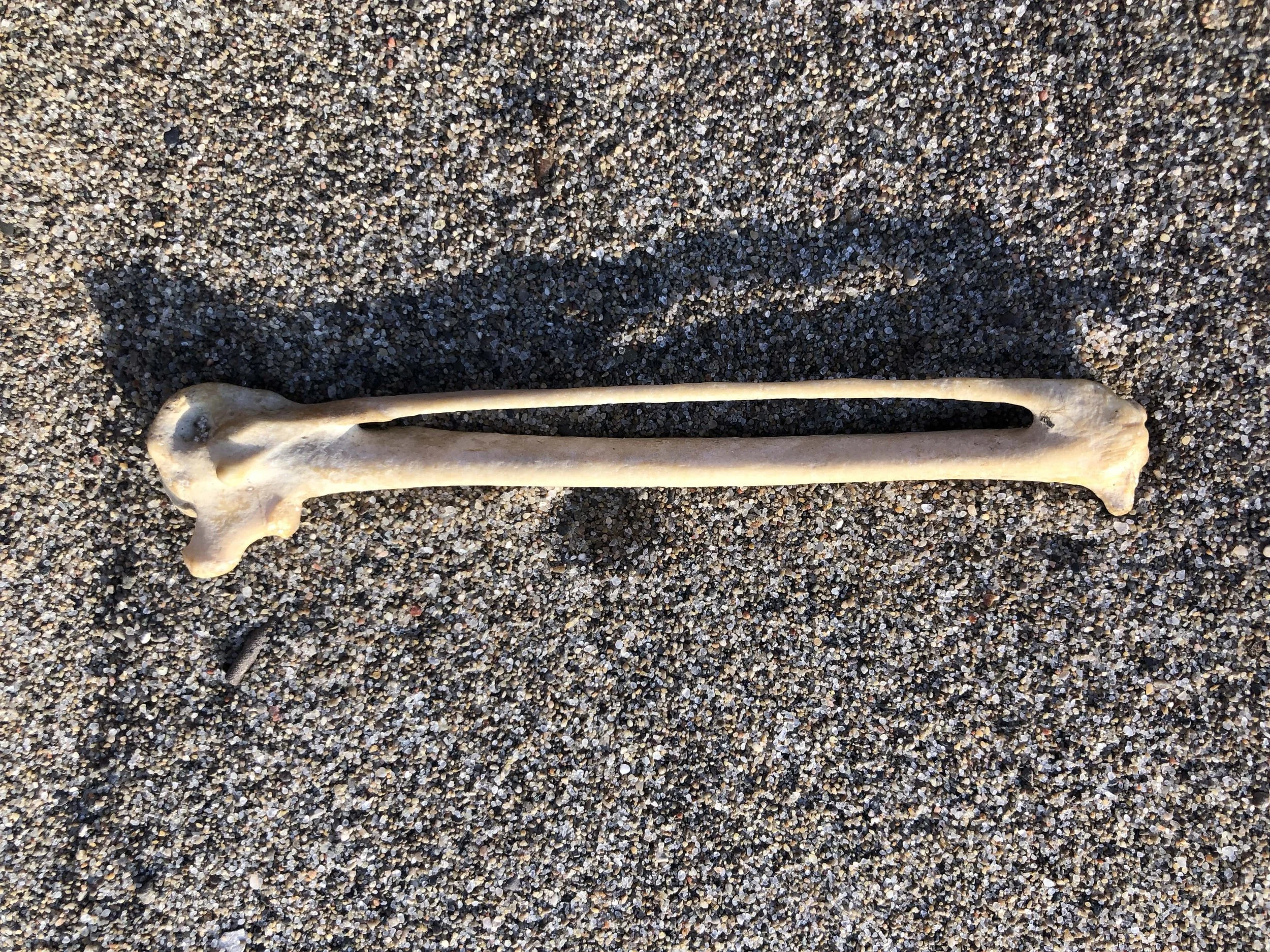
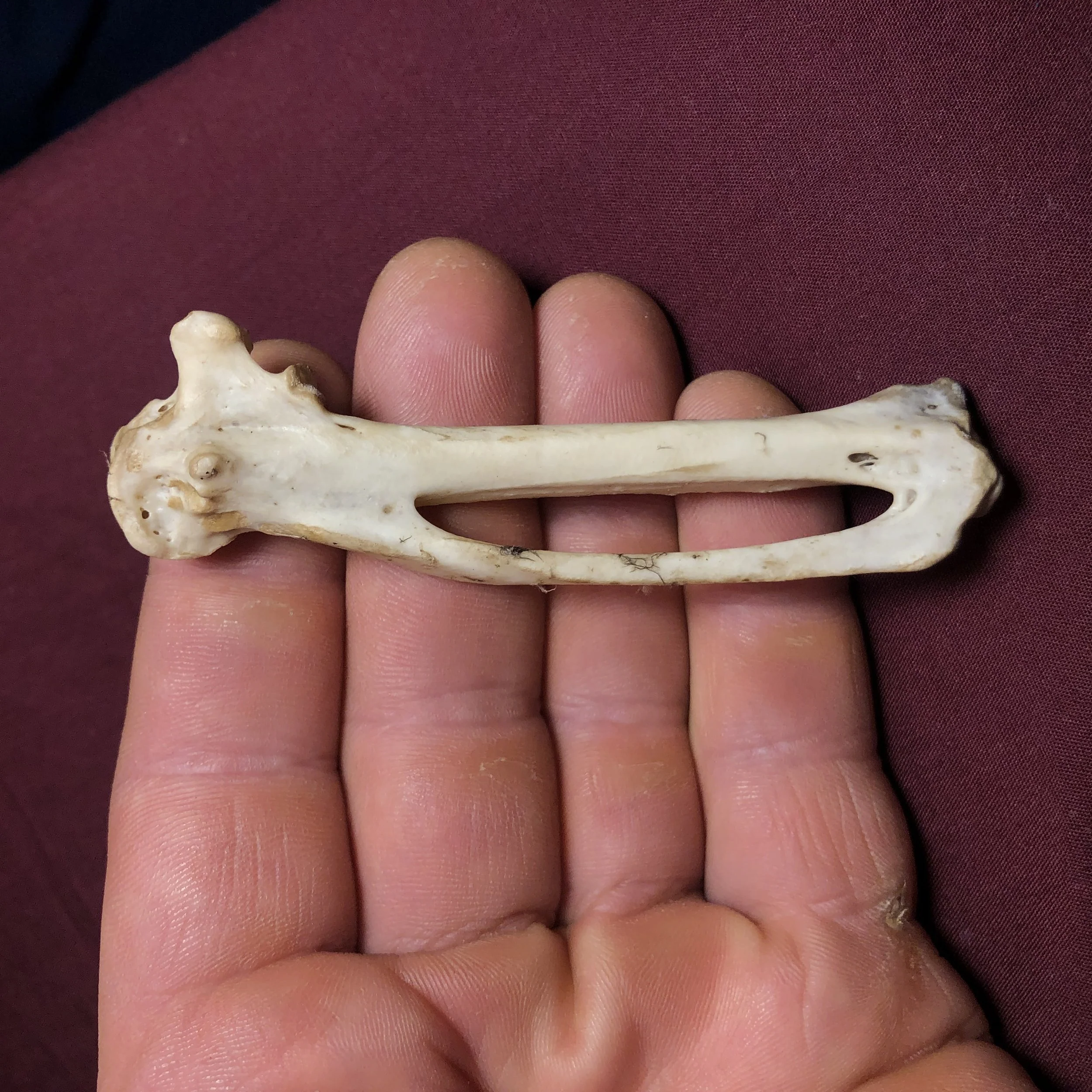
A partner and I went to the beach at Turkey Point the other day and while we were there I went for a walk to examine the tracks impressed in the sand. Not long after started my slow meander, I found a bone washed up in a pile of some sort of lake plant which I didn’t investigate. The bone struck me right away as looking like it was from a bird. Perhaps I remembered it from a previous bone study or from a skeleton I had observed before. I inspected it quickly, and put it in my pocket to look at a little more later before continuing on my way. Returning to our spot on the beach, I showed my partner and took some photos. I began thinking this bone looked a lot like the bow from a bowdrill or from a violin, the heftier length being the bow, and the other the string(s). It reminded me of the ulna and radius, and thought to research who the bone might be from when I got home.
While researching the bone, I began wondering if it was ulna and radius after all? Might it be some other bone? I was pretty sure this was still a bird bone, based on finding it at the beach, and from a sense of familiarity with the structure. But where on the bird body did it reside?
After a bit of researching, I decided that it wasn’t an ulna and radius. Why not? Like humans, bird radius’ and ulnas aren’t fused. They are fused for adult White-tailed Deer, and some other mammals, but not for the birds. These bones were certainly fused.
Ok, so not the radius and ulna.. What else was it? It was a “long bone” implying that the bone must be from a limb so I began looking at some of my books for images of the other bones in the forelimb, aside from the ulna and radius, as I didn’t think it was a leg.
While checking out the book Manual of Ornithology (Proctor & Lynch, 1993), I noticed that the bone just distal (beyond, away from the main body of the bird) looked pretty similar to the bone I had. They had it named as the “Carpometacarpus”. From there I looked up an image on boneidentification.com and noted that the carpometacapus bone of a Golden Eagle (Aquila chrysaetos) looked very similar to the bone I had in my hand. Rolling with this, I checked a few more resources just to be sure, and I decided that this was actually the right bone.
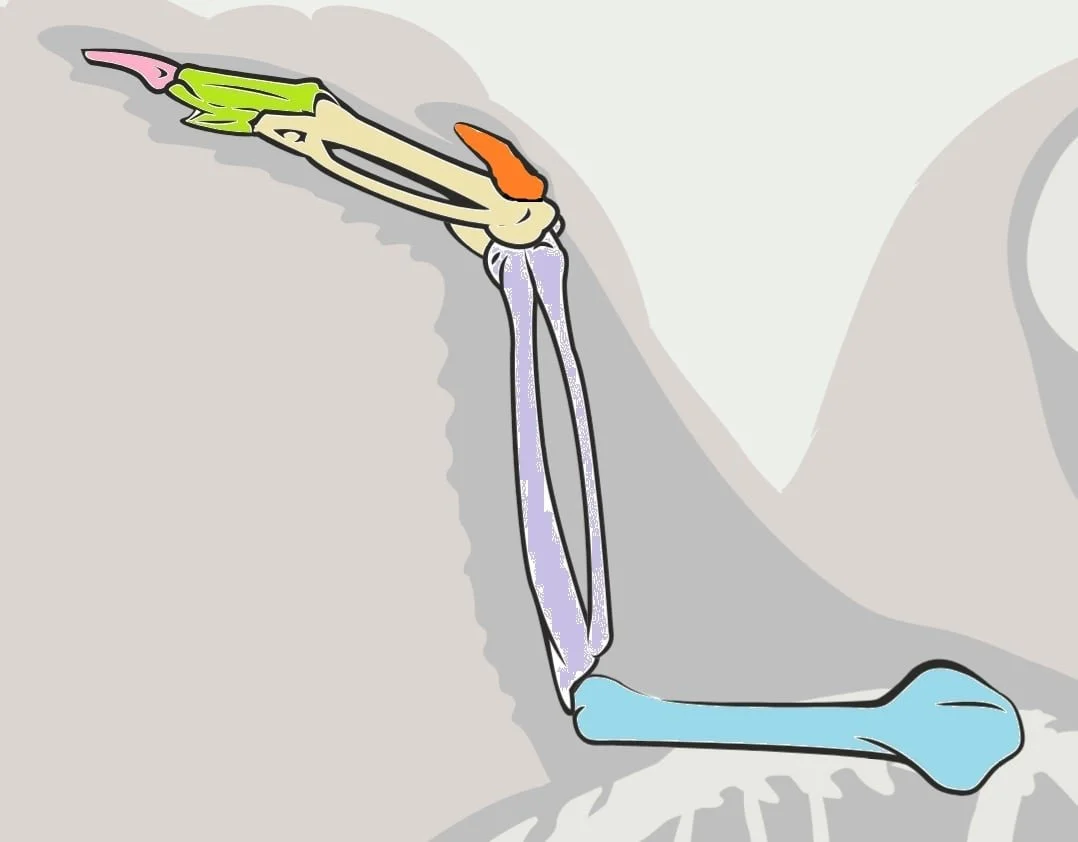
Bones of the wing starting from the outer most and working our way towards the body : Digit 3 is pink, digit 2 is green, digit 1 or the alula is orange, carpometacarpal is yellow, ulna and radius are purple, and the humerus is blue.
The carpometacarpal bone is a fusion of the distal carpals (analogous to our wrist bones) and the metacarpals (analogous to the bones in our palms). This fusion of bones articulates with the ulnare and radiale bones which are nested between the ulna, radius and the carpometacarpus.
Like other bird bones, this fusion creates more stability and therefore less energy is expended trying to keeping everything in alignment during flight. Stability is very important as the carpometacarpus is the bone to which the primary flight feathers attached. The primary flight feathers can spread out or come together in minute tiny movements induced by precise muscle contractions. These movements can create little gaps in the feather tips through which air can flow which help birds lift, though most of the lift a bird needs for flight comes from the secondary and tertiary feathers. The primary feathers primary purpose is to manipulate the air in the upstroke and downstroke. When the birds are in flight they tend to flap their wings in a loose figure 8 pattern, making minute changes in the angles of the primary feathers while doing so. They do this to help create propulsion, similar to the curved blades on a propeller. In fact, some folks think that the carpometacarpus is so important for precision flight, that since the ancient bird ancestor Archaeopteryx didn’t have a long fused carpometacarpus, but instead carpal bones more similar to the T-rex or humans, then that would imply that the Archaeopteryx was a poor flier. As my good friend Dani always says, “sucks to suck.”
Parts of the Carpometacarpus
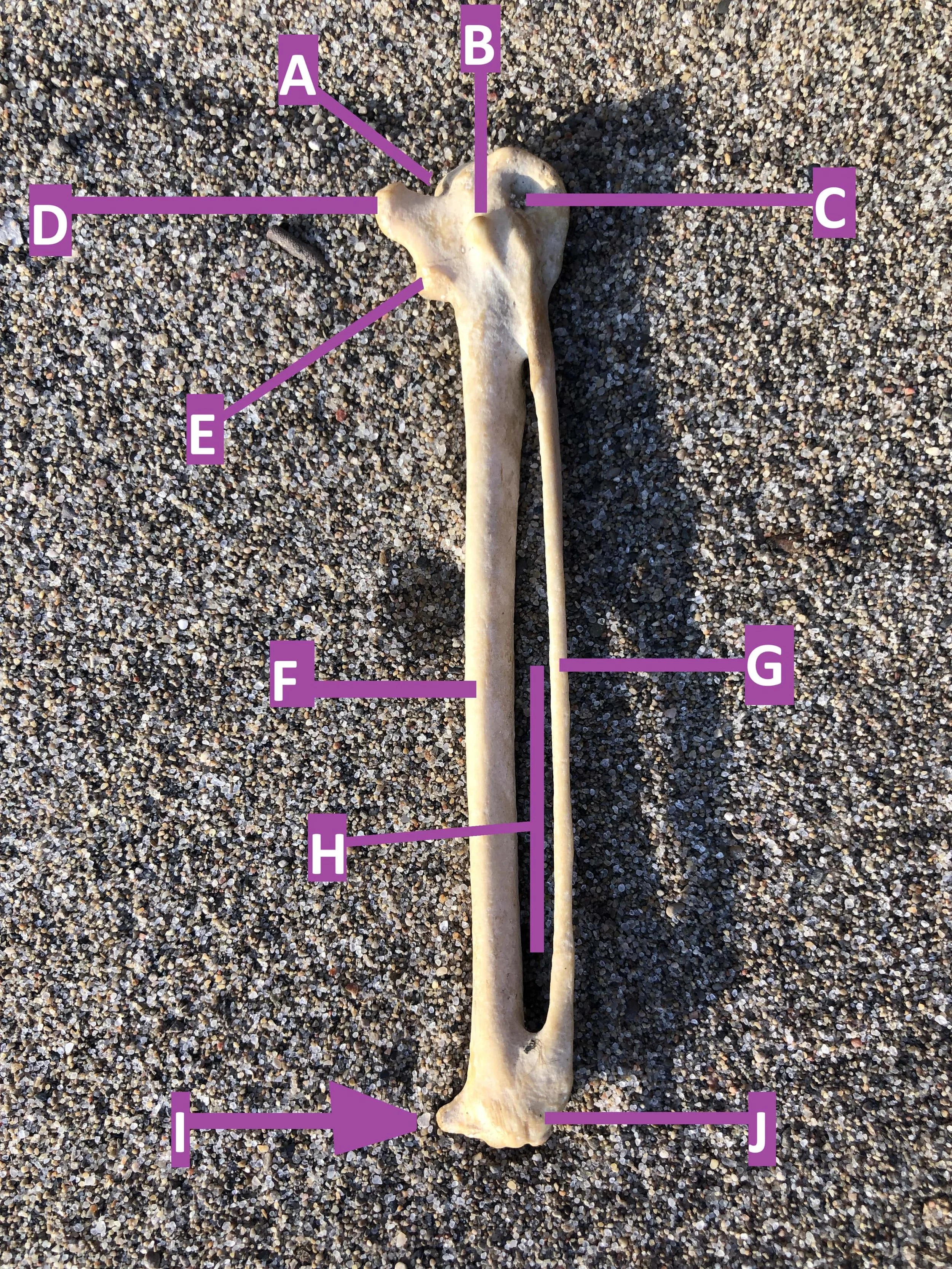

Palmar view (the palm side is facing towards the camera)
A anterior carpal fossa
B pisiform process
C infra trochlear fossa
D extensor process
E alular process
F major metacarpal
G minor metacarpal
H inter metacarpal space
I articular facets for major digit
J articular facets for the minor digit
The top of this image would be the end closest to the body of the bird, and the bottom part of the image would be furthest out on the wing.
Knowing these terms isn’t the most important, but it is helpful in understanding how the more scientific texts are describing aspects of the bone. This, in turn, is helpful in identifying who the bone is from.
When I look at this bone I see that the major and minor metacarpal bones don’t diverge too much, and that the articular facets aren’t so much of an angle that the minor metacarpal bone doesn’t appear to extend beyond the major metacarpal. That helps eliminate a couple of birds (owls, falcons, crow) from a possible match.
Next, I look to the size. 88 mm (3½ in) seems large, so I can think to large birds who might be found around the beach at Turkey Point. I would consider Canada Goose (Branta canadensis), a swan (Cygnus sp.) of some kind, or a large gull like a Herring Gull (Larus smithsonianus). In my research I thought that the bone I found looked a lot like a Mallard (Anas platyrhynchos) but the bone I found was too large, so I thought to check out Goose or Swan to see if they were more approximate in length. According to the Idaho Virtual Museum photographs of a Canada Goose carpometacarpus seem pretty right on, except for colour and shadows, which are purely environmental. I could not find photographs or size comparisons of any Swan species, but I would imagine their carpometacarpus would be larger and perhaps a little more robust.
Another neat thing to do was to try and sort out which side of the body this bone was from. If the top of the image above would be the end closest to the body of the bird, and the bottom part of the image would be furthest out on the wing, and the bone is oriented so that the palm would be facing upwards, then this would indicate that this carpometacarpus is from the right wing of the Canada Goose. There were some more complicated means of determining the side of the body in some of the books, but I found them difficult to understand. Instead it made more sense to me to remember that the hooked end was where the alula is. If we take a leap and think of the alula like a thumb then it makes sense that the alula would be closer to the wrist. That also means that the flatter end was where the other digits are located, away from the wrist. Coupling this with the notion that the pisiform process (B), the sticky outy on the bit on the alular end is on the inside of the birds “hand” then we realize that this is the right hand of the bird.
Here is a photo of a carpometacarpus from a Turkey Vulture (Cathartes aura). Try and sort out the side it’s from.
Which side of the body is this Turkey Vulture carpometacarpus from? Answer after the resource list below.
As I finish up this blogpost, I am feeling joy as today I found another carpometacarpus and I can start on a new mystery. I really do love this game.
To learn more :
Manual of Ornithology by Noble S. Proctor & Patrick J Lynch. Yale University Press, 1993.
Bird Tracks and Sign by Mark Elbroch, Eleanor Marks, Diane Boretos. Stackpole Books, 2001.
Idaho Virtual Museum photographic collection of Canada Goose bones
Avian Osteology by B. Miles Gilbert, Larry D. Martin, and Howard G. Savage. Missouri Archaeological Society Inc, 1996.
* The carpometacarpus is from the left wing of the Turkey Vulture.