River Otter on the Eramosa River
On Wednesday December 17th, 2025, while out exploring the river ice with my students we came to a bend of the Eramosa River where I knew the ice was thickest. They wanted to slide around, I wanted to track the edges in hopes of finding some Coyote (Canis latrans) tracks. When we first stepped on to the ice I did notice two Coyote trails, likely two individuals from the pack who have been in the area recently. I walked along more and noted a likely Sorex shrew trail, which I decided I needed to investigate further once I did a round before the kids stepped on anything else. I crossed over the ice to the other side of the river and came across a wider trail which upon an quick glance I thought was more Coyote trails. After telling the kids the boundaries of where I thought it was safe for them to slide on the ice/where I wanted them to stay off the tracks, they got to playing and I walked the boundaries again to investigate further.
The first tracks I looked which made me reconsider the species
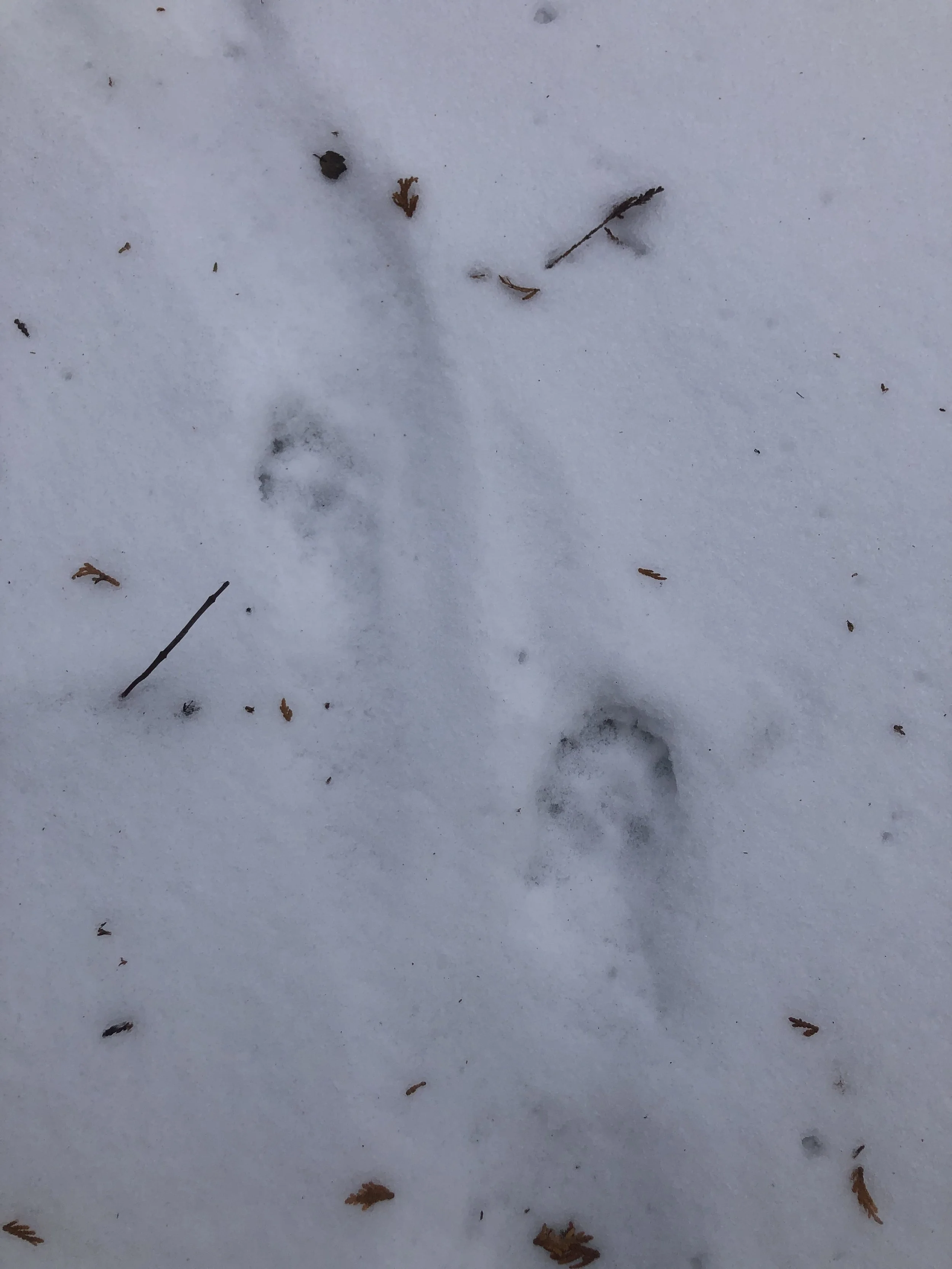
At first, I thought the trail along the far side of the river was Coyote. The trail was about a meter away from the bank, and had what appeared to be a mix of long drag marks and some foot prints within. The trail hugged a smooth slate like beach, ducked under an Eastern White Cedar (Thuja occidentalis), went on to hug an old concrete supporting wall/footing for a long since removed railroad trestle, and then off into the Cedar woods where I could not follow while the kids in my care we playing on the ice. They appeared to be investigating the edge of the ice, but never up on the land.
The tracks seemed a little off, but it was been a warmer day and I initially thought that the variation in the track might be due to melt, or perhaps a double register. But when I stopped and looked a little deeper, I began seeing that the toe impression closest to the midline of the trail was in the right place for a toe 1 on a mustelid. I dropped the possibility of a Coyote and I quickly considered Fisher (Pekania pennanti) because they have been showing up more and more in my area. Or, could this be the trail of a River Otter (Lontra canadensis)?
Guelph was once part of the historical range of Fishers and River Otters, but due to anthropogenic impacts on the land, like deforestation turned to farming, which turned to urbanization in the context of Fishers, or unregulated trapping, vehicle collisions, pollution and wetland destruction in the context of River Otters, the land could no longer support the needs of either population.
Fishers need intact mature forests with large dead trees marked by cavities (usually trees are larger than 40 cm diameter where the cavity is), or in large brush piles (coarse woody debris) for nesting and resting needs. Over the past 50 or so years where I live in of Southern Ontario has seen more concentrated efforts towards better forest management, moving away from clearing land entirely or planting mechanistic Pine (Pinus spp.) plantations and instead moving towards species diversity, selective logging, allowing remnant snags (dead trees) to stay in the forest, and allowing an accumulation of coarse woody debris. All of this along with a high population of Porcupine (Erethizon dorsatum) and other prey species, contribute to suitable Fisher habitats. So this could very well have been a Fisher trail.
Southern Ontario conservation authorites currently are mandated to look after specific watersheds, and their work over the past 85 years has shown that what they are doing is generally good for the watersheds they manage. The rivers are generally healthier, and can support life which had been locally extirpated, such as the River Otter, from across much of the area. River Otters are known to be sensitive to pollutants and can accumulate heavy metals, organochlorines, and other chemicals from all the other animals they consume as an apex predator in their fresh water ecosystems. If the river isn’t healthy, then fish, turtles, birds, crayfish all end up consuming those pollutants. Since the River Otter consumes all those primary consumers, then the Otter accumulates even more concentrations of the pollutants. So if the river isn’t healthy, the Otters aren’t healthy. So seeing signs of River Otters would be an indicator of a healthy aquatic ecosystem.
While River Otters are still rare in and around Guelph, they do seem to be slowly recolonizing the area around the city. Dr. Brian Husband, professor at the University of Guelph shared photographs with me of his sighting on December 27th, 2021 the Eramosa River near Eden Mills, which is about 6.5 km away from where I found these tracks, and looking at INaturalist, Chris Earley, naturalist at the University of Guelph Arboretum shared photos of River Otter tracks about 4.5 km North in the Rockwood area taken three days after Brian Husband’s sighting. Of course these are 4 years ago, but that shows that River Otters are once again in the area. Again, according to INaturalist, there have been 5 confirmed sightings of River Otters or their tracks within 20 km of the spot where I found this trail, plus some uncertain claims I have received through readers of this site, or on INat. Personally, this would be my first time finding sign of River Otter tracks on the Eramosa, so I was stoked at the possibility.
I ended up trying to step back from the individual tracks and taken in the whole scene, noting anything else on the ice that might point one way or another to clarify if these were Fisher or River Otter tracks. They are both larger members of the Mustelidae (Weasel) family and their track sizes do overlap and while mustelids usually have similar looking track morphology to some extent, Fishers and River Otters are pretty different from each other. A few things in common would be their large feet with 5 toes on both front and hind feet, and a carpal pad on the front foot which sometimes registers and a pronounced asymmetry on the hinds. From here there are distinctions.
River Otters have webbing on their feet that sometimes shows in the track. Fishers do not have this. River Otters do not have a lot of fur on their feet, while Fishers do, and this hair often renders the Fisher tracks a bit blurrier. In some substrates the toe bones of the Otter show in the track, while the Fisher toe bones do not show, again, usually due to their furrier feet. The hind tracks of an Otter are larger than the fronts, while the fronts are the same size or larger than the hinds on a Fisher. Otters travel overland taking direct routes while Fishers wander and circulate a lot of the time, crisscrossing a trail, investigating. Finally, an important difference is that Otters slide way more frequently than Fishers. Fishers tend to do most of their travel oriented sliding while going downhill, letting gravity do the propulsion work, and often, if it’s not downhill, the purpose is less so about travel and more so a scent marking behaviour. Otters slide on level and sloped surfaces, using their hind feet to propel them with a trail width ranging between 15.2 - 25.4 cm (6 - 10 in).
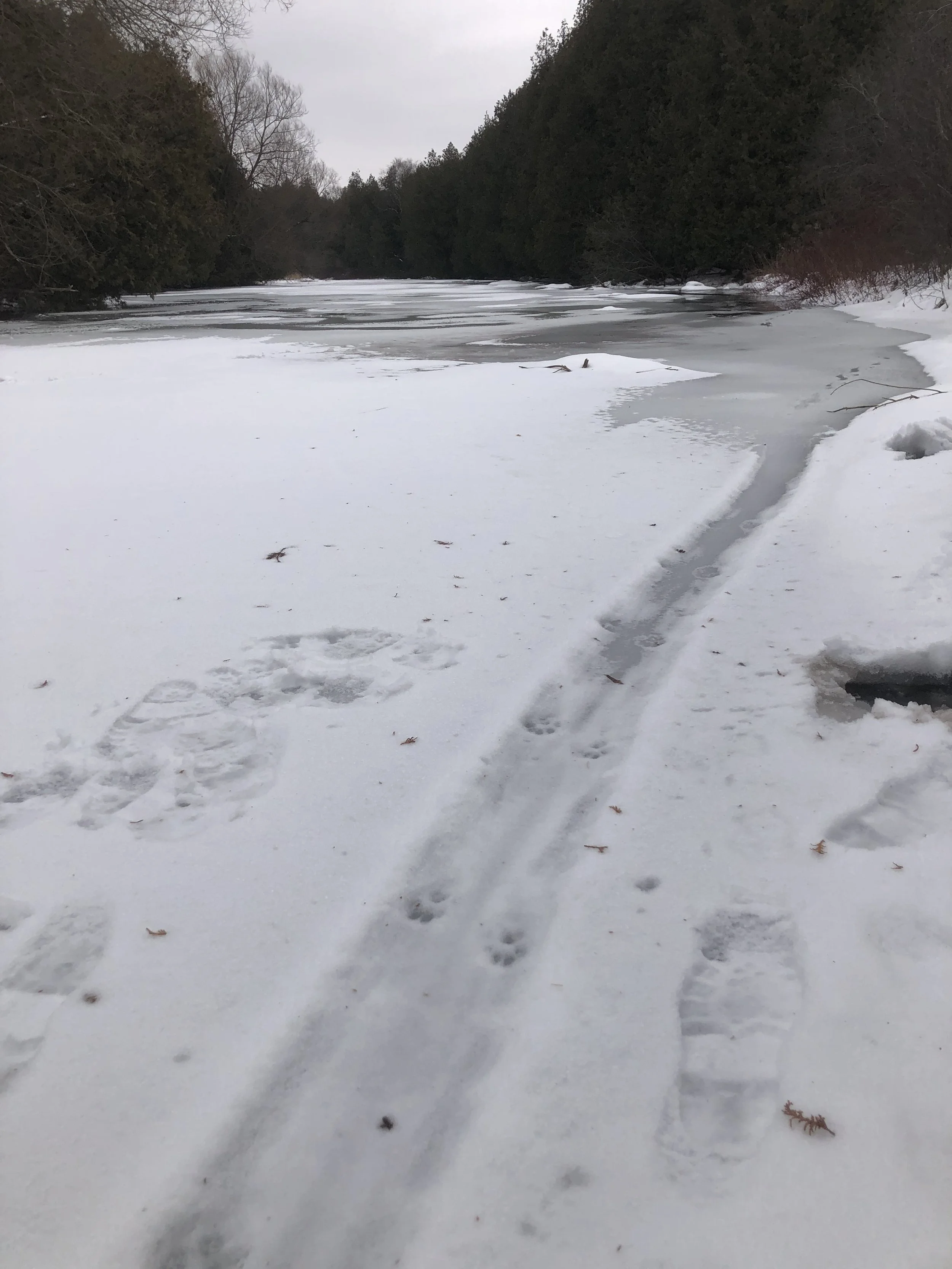
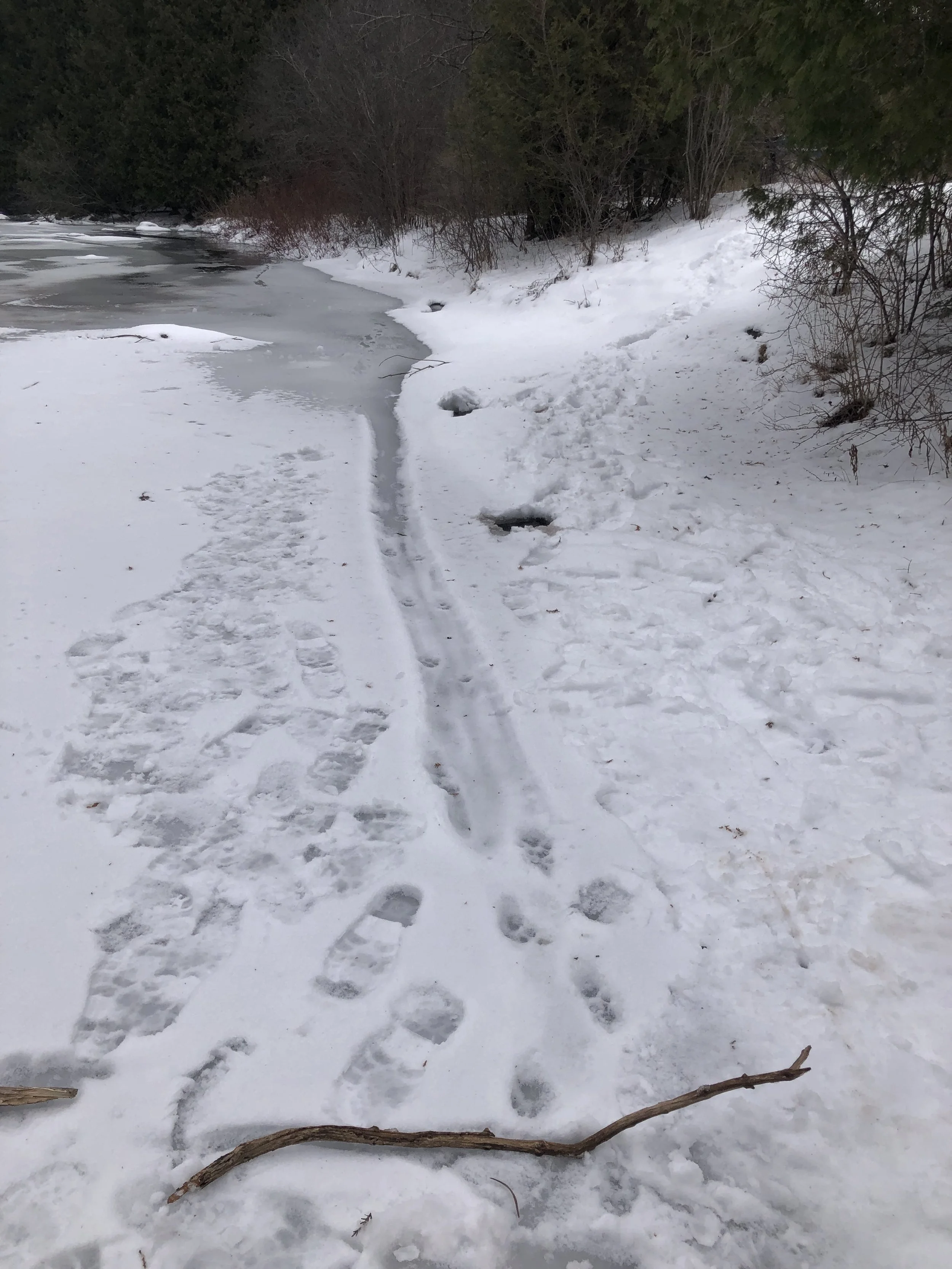
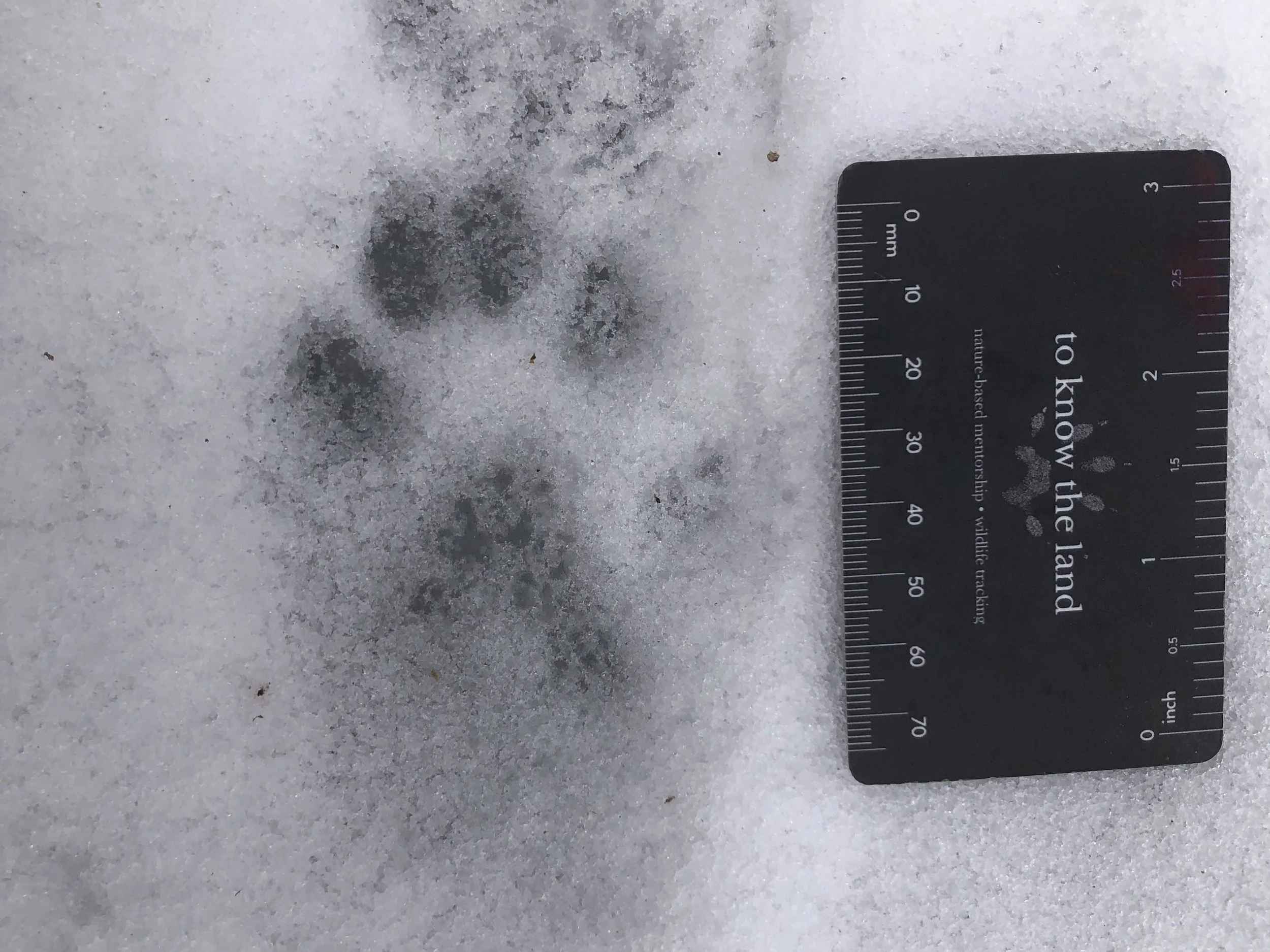
The slide trail width came in between 17.75 - 21.5 cm (7 - 8½ in) and the trail width for where there were just the tracks of the feet was about 17.78 cm (7 in). I also took measurements of the tracks of the hind feet in the slide, just to keep a record for the future. They came in, toe to toe on the slide, at about 50.5 - 54.5 cm (20 - 22½ in). When I measured one of the hind feet, from leading edge of the toes to the back of the metatarsal pad, it was about 7.7 cm L x 7 cm W (3 in x 2¾ in), which fits the numbers in Elbroch and McFarland (2019).
Since finding these tracks on the Eramosa I have been reading about River Otters expanding their range. Most of the sources are from the U.S., but the situation still applies across most of Turtle Island/North America. One article I read explains that River Otters are expanding their range throughout Southern Ontario, including in the Grand River watershed, within which the Eramosa River is located, and the Credit River watershed, which is East of us.
As our culture learns better ways to be in relationship with the rivers, to stop polluting them, burying them, damming them, and destroying the riparian communities along their banks, then the River Otters will return and thrive.
Here’s to finding more of their tracks along the Eramosa in the future.
To learn more :
Pictorial Guide of Important Fisher Habitat Structures in British Columbia (pdf)
Confirmed River Otter sightings on INat within 20 km radius of the tracks I found.
Do Fishers Slide? What about other Weasels? article by Janet Pesaturo
Peterson Reference Guide to the Behavior of North American Mammals by Mark Elbroch and Kurt Rinehart. Houghton Mifflin Harcourt, 2011.
Mammal Tracks and Sign, 2nd ed. by Mark Elbroch and Casey McFarland. Stackpole Books, 2019.
River Otter Status, Management, and Distribution in the United States: Evidence of Large-Scale Population Increase and Range Expansion by Nathan M. Roberts, Matthew J. Lovallo, Shawn M. Crimmins. Journal of Fish and Wildlife Management, 2020. (pdf)
Otters by Don Scallen. In the Hills magazine, March 2020.