Signs of the White-tailed Deer Rut
I was out with the Earth Tracks wildlife tracking apprenticeship at Mono Cliffs Provincial Park the other day, tracking with the intention to trail some White-tailed Deer (Odocoileus virginianus). This is a challenge for me. Not the finding of tracks, but the following of trails in anything but mud and snow. Leaf litter, even in the wettest of leafy debris is a struggle for me so it was a good day to watch and observe others who are better at trailing than I am, while also working on my own skills when the substrate got easier to read.
We started walking East in an alley of Spruces, mostly Norway Spruce (Picea abies) and everyone started to veer South towards an open field of Goldenrods (Solidago spp.) and Asters (mostly Symphyotrichum spp.). I ended up staying in the Spruce alley as was finding some interesting Coyote (Canis latrans) scat composed mostly of Apples (Malus domestica). This is something I have seen a lot of this time of year and while I am still impressed, I didn’t spend a long time with the Apple scat. Instead, my attention was hooked by a small dark bit of soil that stood out amidst the mosses, leaves, and fallen Spruce needles and cones which littered the earth.
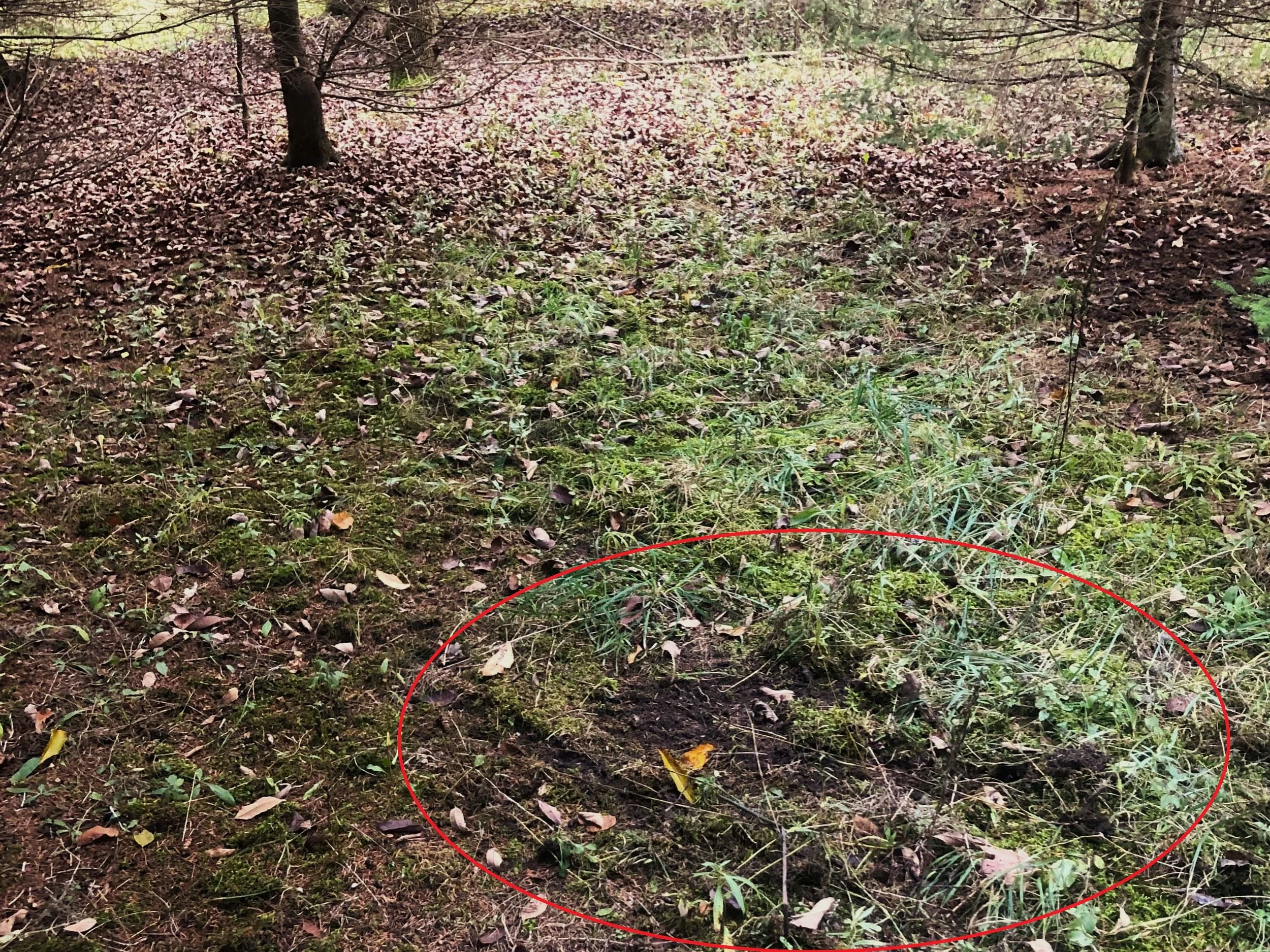
Tracking and trailing is all about noticing these disturbances in the baseline of the landscape. What sticks out? What is different from the patterns which clothe the land? This scrape was certainly a shift in the pattern and therefore caught my attention. When it did, I looked carefully at the scrape for a moment, took some photos, and then dropped my ruler in the sort of egg shaped exposed soil and stepped back to get a few more photos.
It was at this moment that I heard some rustling from the North of me which sounded like someone was running into the woods. I froze, expecting to encounter a human anxiously running, when I watched a high energy deer come run into view, then stop maybe 5 or 6 m ( 15 - 18 ft) ahead of me, with head bowed and apparently sniffing the air. They themselves quickly appeared to freeze, bracing their limbs. They then gave a quick snort or loud blow of air from their nostrils and then leapt and bounded back towards the way they had come in. This all took maybe 6 seconds to occur. I ended up getting an incredibly blurry photo of the deer heading away from me, but I was too enthralled in the moment to pull out my camera sooner.
Even when the deer had left I remained frozen in place for a couple of seconds in case another deer may show up or if the deer may return, but once I realized there was no return, I quickly left the scene to go retrieve the rest of the tracking crew to share the story and examine the scrape.
Scrapes are created by male White-tailed Deer throughout the year, but mostly during the mating season, which is lovingly called “the rut”. The rut takes place between mid-October through to first week of December, maybe even into January, but I believe the peak is throughout November where I am located in Southern Ontario. During this time female and male deer are leaving scents and sign all over the woods to advertise their intent to mate. While this is an ancient event playing itself out year after year, our knowledge of the details of the rut is always expanding and deepening. This also includes new understandings of what is happening at a deer scrape.
Conventional knowledge tells us the basics; White-tail males will paw at the ground with their fore feet creating a shallow egg shaped to circular depression into the ground. This is essentially the scrape. These scrapes are touched up often by the first buck who created it, but also visited by other deer as they come across them. They are created by young and old bucks (male deer), but it’s about 85% mature males who are “opening” most of the scrapes.
While the buck works the scrape, again scratching away at plant material and revealing the soil beneath, researchers believe he is depositing scent. How? A little bit up from between the digits (toes), on each of the deer legs, there is a gland which secretes a fatty substance which is applied to the substrate with each step the deer takes. This includes these scrapes. From what I am learning, this substance appears to be pretty unique in odour to each individual deer. Some humans (Homo sapiens) can perceive this odour, but personally, I cannot. For deer though, this uniqueness is so pronounced that does can find their fawns by following this scent. Bucks, or male deer, can track females during the rut (mating season) following this scent as well. I think it’s kind of funny to think of the scent coming from between their toes being so important during the rut, but, you know, animals be animaling.
Additionally, though only during the peak of the rut season, after the male is through scratching at the ground, he’ll bring his hind feet up to the scrape, bring his back ankles together and then urinate down his legs and dribble into the scrape. It’s true. Why? Well, the tarsal gland sits on the inside of the leg where the tibia articulates with the metatarsal on the deer’s hind leg. If a deer were a horse, we might say they were located on the hocks. For humans, we would call it the ankle. This gland often named as the most important of the leg glands in that the secretions from the glands and the bacteria they accumulate contain chemical notes which may let other deer know, not only who the deer is, but also the relative health of the deer who left the scent.
Tarsal gland of a White-tailed Deer
Imagine a mature buck standing in place amidst the peak rut. He just started scraping at the ground with his front legs. As he is standing there, he puts his hind legs together at the tarsal glands and then urinates on his legs, dripping through the hairs on the tarsal glands then on to the newly bare soil. Mature bucks do this behaviour more so than other deer during the rut, and that urine mixing with the oily waxy secretions gets pretty powerful.
The long dark hairs at the tarsal glands catch the oily goo produced by tons of the sebaceous glands beneath the hairs. The fatty goo coats the hair and helps hold some of the urine and then the bacteria get in on it and it creates a powerful rank odour.. As the urine runs down the buck’s leg, he then stamps his toes into the ground when they create a scrape.
It’s not only the mature bucks though… old and young, male and female, will all demonstrate this rub urination behaviour. It seems from the literature I have read that perhaps folks once only saw this behaviour in males, but now, especially with a ton of trail camera footage, it seems researchers are noting that females have been doing this behaviour as well. Everyone is leaving scents all around the forest letting everyone else know their getting ready to get down.
We decided to walk on and folks would try and trail the deer I just saw, and to be honest, while I found the first tracks of exactly where the deer stood, crouched and inspecting me, I could not find another track amidst the Goldenrods they had bounded through. I write they because I can’t be sure that this was a male I had seen; I didn’t make out any antlers, and even if I did, some females have antlers as well. While I can’t be certain, the deer lowered their head at me in an “antler threat” display as Stokes calls it (Stokes, 1986), and there was a lot of “big neck energy” in how they moved about.
Some folks in our group are much better at trailing than I am and so they took the lead in trying to follow the deer who had I encountered but the trail was rough going. Soon, some older trails were picked up and followed in hopes to get on some fresh ones again. I have been reading that in the month leading up to the rut there is a lot of deer energy moving across the landscape so these old trails would be common in the area. Scrapes are scraped, urine is sprayed, scent marks are made throughout their territories.
Dark path through the leaves shows the deer trail
While others were on the trail I was off to the edge of the gently sloping forest walking about a meter (~3 ft) away from a steep cliff face looking for an easier way down to the valley below. These cliffs were high limestone walls of the Niagara Escarpment, and definitely deadly if I tried to scale most of it. I had to be focused on my own navigation and was pretty much ignoring a lot of the others who were following the deer trails, but I am grateful they were on those trails. It didn’t take long until the deer’s trails led us to a safe incline we could descend if we followed where they had gone before.
This was a steep path. Clear tracks were visible in the bare soil which had been kicked up on the way down, and as we made our way further, there were some less sketchy terraces where we could easily make out the trail through the leaf litter as the deer had turned up many of the fallen leaves in their descent. This was all highly visible for my untrained trailing eyes and was both grateful for the deer showing us a safe way down, but also for the incline which must have been a factor in compelling the deer to dig into the leaves with more force to stop themselves from tumbling down the hill. This trail was visible all the way to the valley floor where we were met with some scat which appeared wrinkled and moist on the outside but also dried out a bit on the inside. Alastair, a fellow tracker in our crew, had mentioned something he heard at a track and sign evaluation recently from the evaluator, Nate Harvey. Nate had mention that new deer scat has a mucus coating that tends to dry out or disappear after a couple of hours. The scat we found was wetter on the outside, but not like the mucus covered scats I have found in the past. I also remember learning a few years ago from Alexis that if we come across scat that looks fresh, maybe because it looks like it is still covered with mucus, with lines and ridges sort of like raisins, then the scat may not actually be as fresh as we might initially presume it to be. Instead it may be that the scat has froze, then thawed. The moistness would come from the melted snow and the ridges and lines in the scat are from the drying, desiccating action before hand. This is helpful for aging scat, especially in the context of trailing.
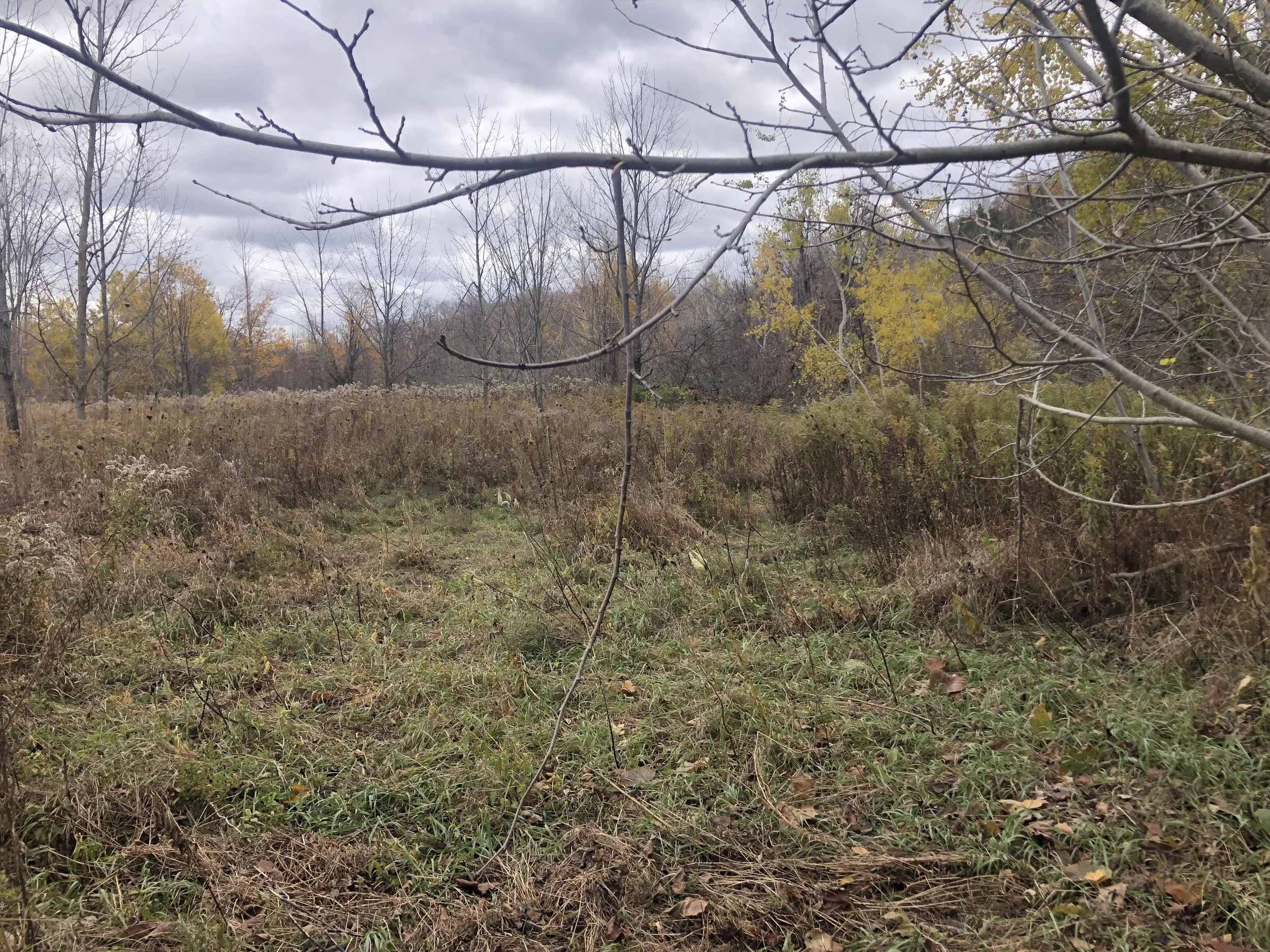
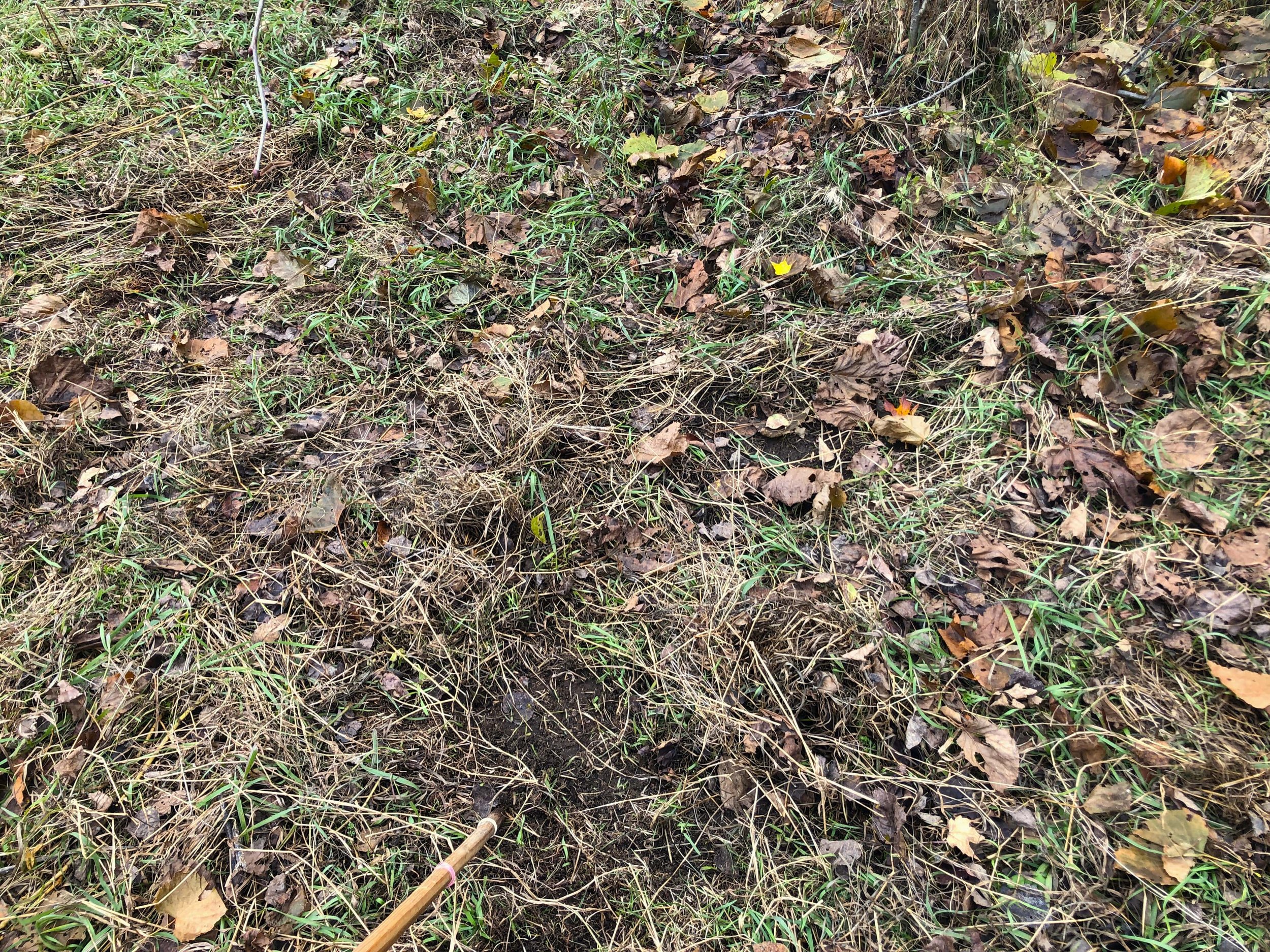
Out in a bit of a clearing, just beyond the scat, an awesome discovery was made. There before us was a Basswood (Tilia americana) off to the right of the trail with a long limb stretching out into the path. Dangling from the limb was a long branch that had been broken and hung in the middle of what would be the trail, had it been more defined. The large limb itself hosted a large bright orange gash on the underside where the bark had been violently rubbed away. Below the limb, where it crossed the deer trail we had walked up on, were three scrapes into the earth, where leaves, grasses and forbs had been scratched away and bare soil stood out like a bruise.
These were the signs a buck, and perhaps a couple of them, and when considered all together, signs of the rut. I mentioned the behaviour and purpose of the scrapes above, but I want to touch on a couple more here, namely rubs, which I have encountered often and think I understand, and lick branches, which I have seen less and don’t know as much about.. yet.
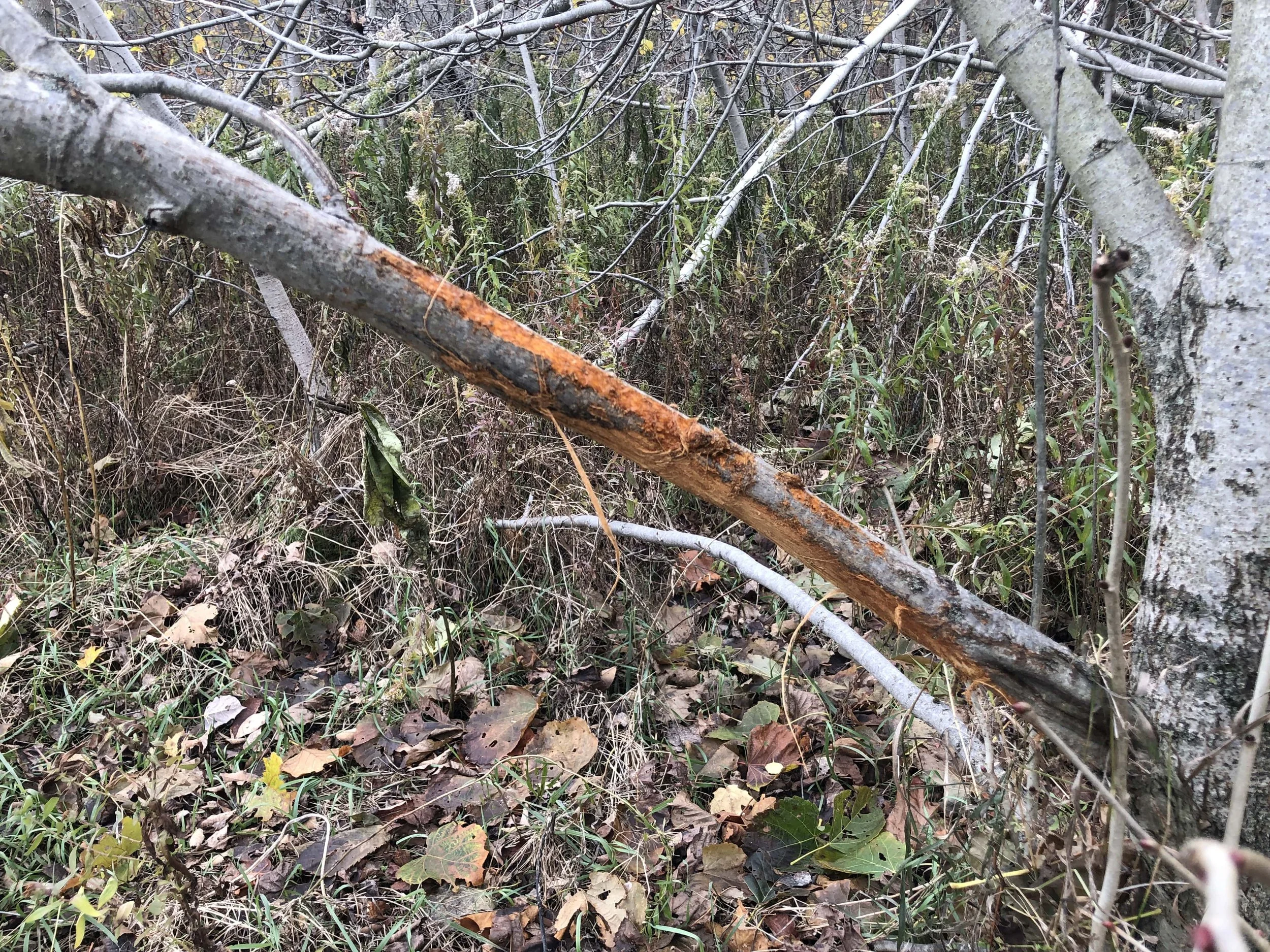
Rubs are created when males vigorously rub their antlers up and down against a trunk or limb of a tree, scraping off bark and revealing the brighter pale wood beneath where the bark once was. This rubbing serves a few different purposes as the Autumn goes on. First, during the pre-rut period, males rub to help shed the velvety layer of skin-like tissue that once enrobed their antlers, nourishing the antler bone and helping them to grow. As the Autumn comes on, the antler velvet stops getting nourishment from the body, and triggered by changes in length of daylight (photoperiod) and the increasing testosterone in the male deer’s body, the velvet dies back. Researchers think that this dying velvet likely becomes itchy or uncomfortable in the process. So the deer want to scratch it off, and so they rub against trees to help with this process. This dying flesh the deer are rubbing off likely leaves a scent, which is then deposited when rubbed against the tree.
Later in the season, bucks also begin to deposit the scent of fatty secretions from a gland in their forehead on to the the bare wood of the rub. These fatty secretions from the forehead gland really start coming out during the peak rut period when the bucks are revisiting previously made rubs of the year, redepositing scent as they go.
The scent sticks around, and the sight of the newly exposed wood highlights the scent. Something really interesting about this sign posting behaviour that has just come to be known by western science is that due to the deer’s ability to see in lowlight and ultraviolet light these rubs appear like glowing patches in the darkening landscape, highlighting these horny message boards for all the deer in the area to check out.
Deer can see colour different than we can, especially in blues and purples in the ultraviolet spectrum (I used to go out tracking all the time in blue jeans. Never Again.) which are more visible around dusk and dawn, which are times of peak activity for the deer! What causes this radiance? It might be terpenes (think of that lovely piney odour) in the sap of the trees, it might be from chemical secretions in the forehead glands, or a combination of both of them. Turns out that this glow in the dark phenomena also occurs in the urine deposited at scrapes during the rut! Just a big glow in the dark party for the deer.
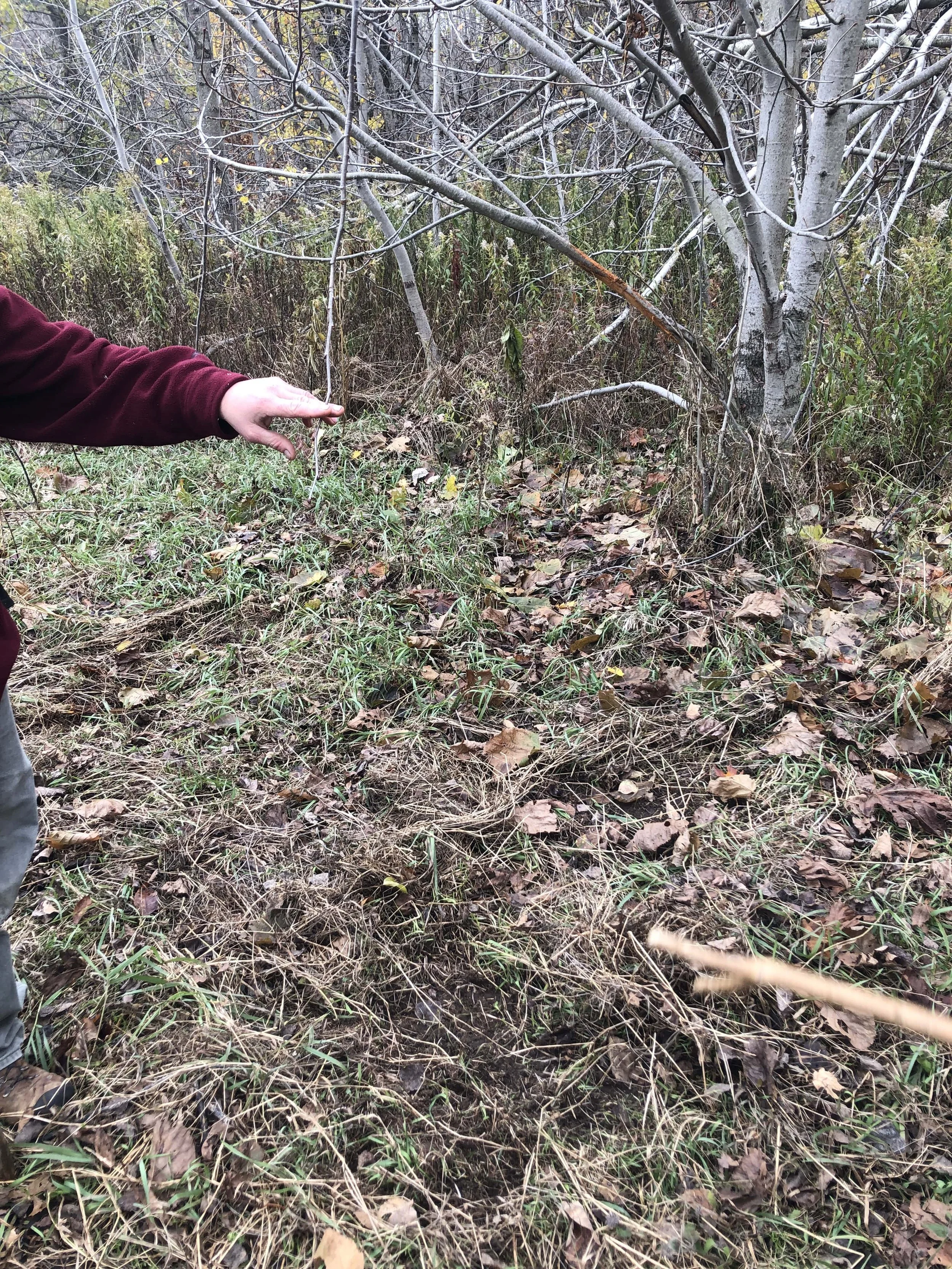
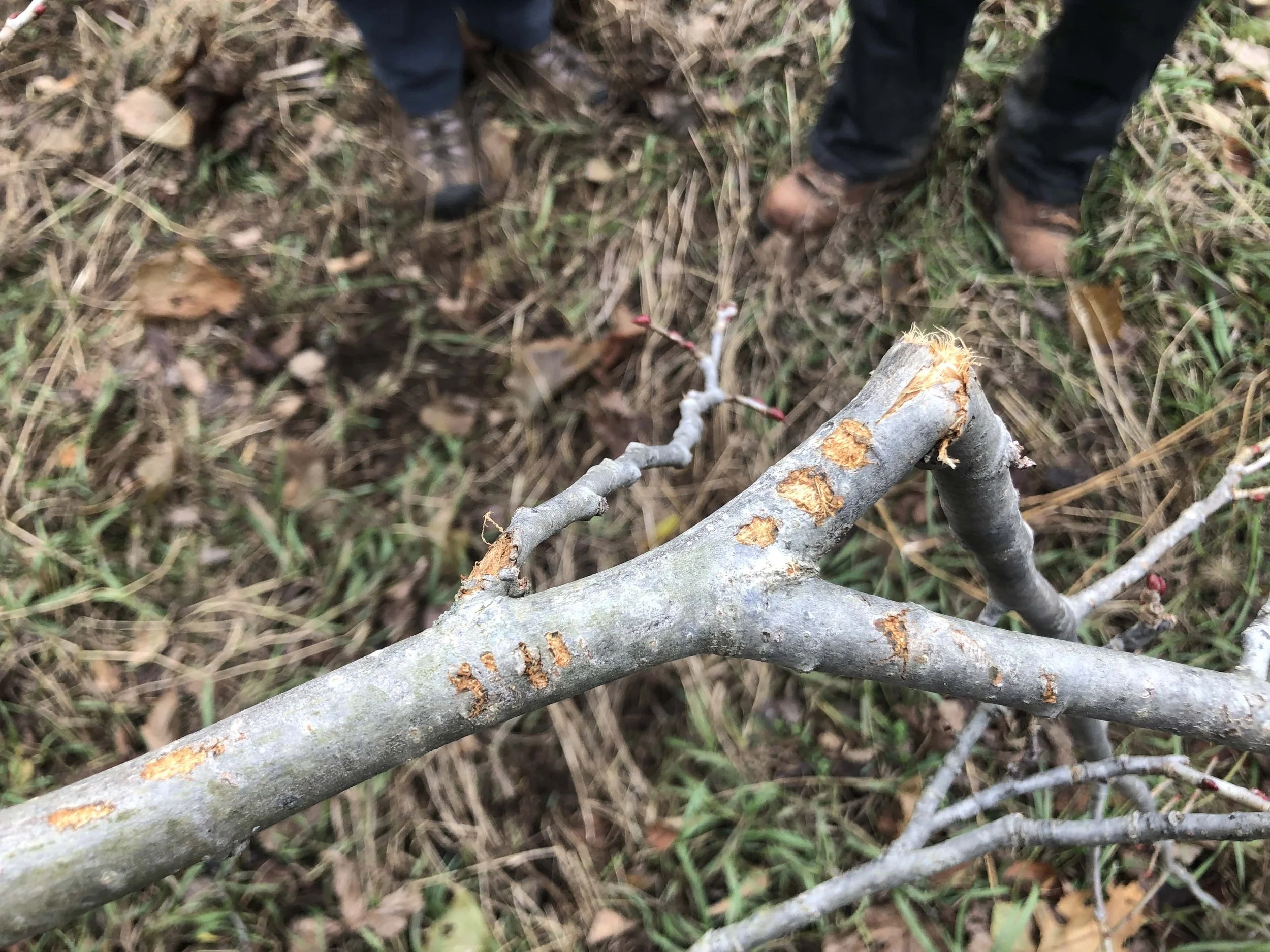
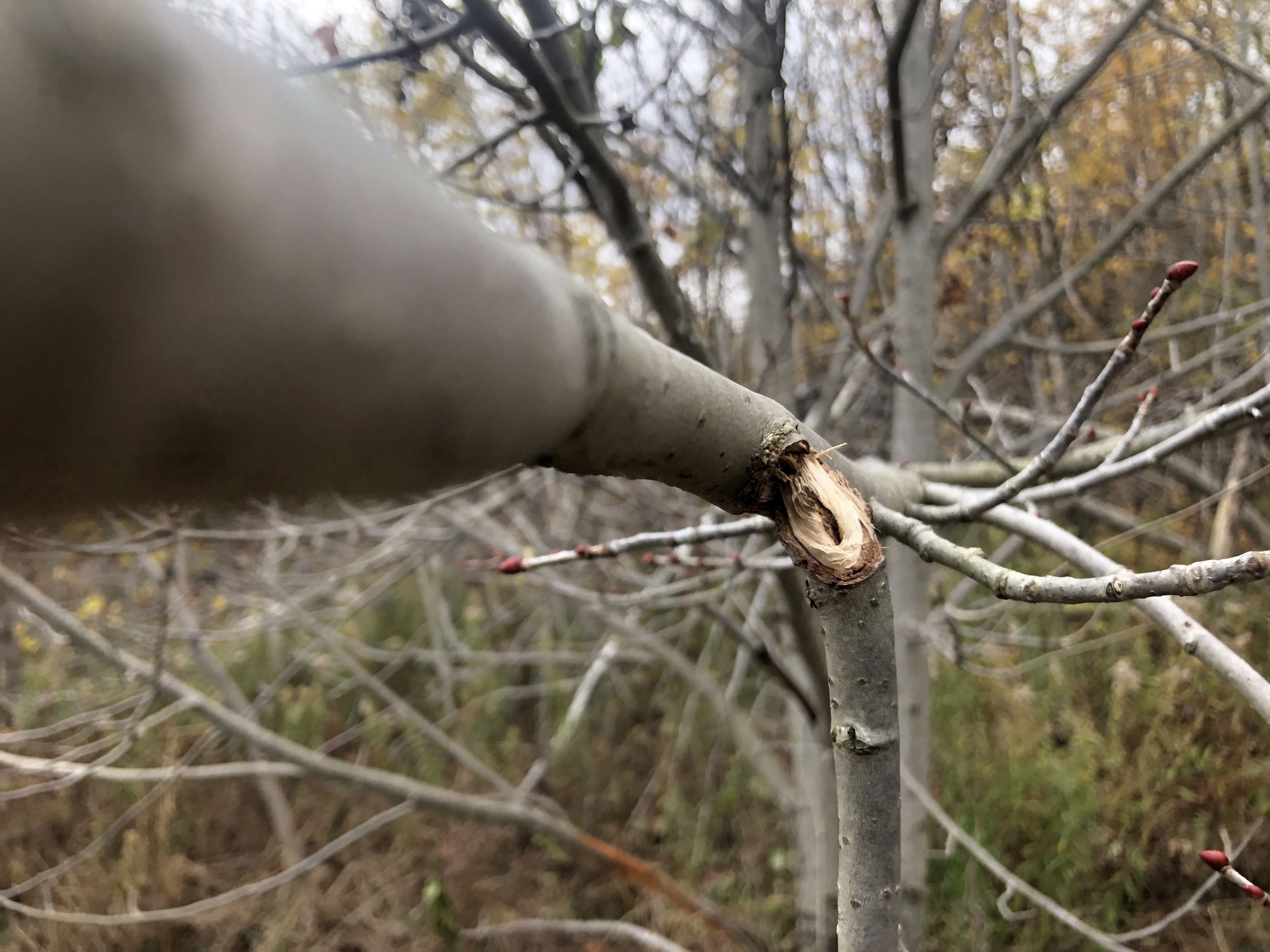
There was also the lick branch. Up until now, all I knew about lick branches was that deer break branches above a scrape and sometimes mouth them a little. Why? I didn’t know. Which deer? Same. Was when important? Still didn’t know. This was something else I had to investigate. I have seen them before, but never really dug into the whys, whos, whens and hows.
I have learned that lick branches aren’t just about the rut. In fact, one book I was reading (Deer, 1995) describes the lick branch as a Spring-Summer social communication hub where identity and status are shared with between bucks. Think of it like sticky notes left on the water cooler. Deer come along through high traffic areas and make a scrape. Remember, scrapes are made throughout the year, they just get more popular come the rut. The buck then grabs a branch hanging out just above head height, which is hanging over the scrape and begins to lick it and mouth it a little, and then rub the glands located in front of their eyes (preorbital glands) all over the branch, and move on. If the buck comes across a branch already in play, then they’ll still leave their scent on it by licking and mouthing the branch, but they’ll also be smelling, and maybe tasting, for other bucks who have come along before them, possibly trying to pick up on who’s who in the area. Folks aren’t sure how specific branches are chosen, but there must be something to it. Maybe the deer just think their cool for some reason? I think of the folks who make videos of cool sticks they find and share them online. Maybe this is the deer’s way of doing the same?
A cool thing we saw on this particular branch, as shown in the second photo of the group of three above, are small marks likely created by the molars of the deer while chewing on the branch. This likely works in some of their scent a little bit more than just licking, helping to hold the scent longer, thus leaving an enduring mark at this site. This is something I had never seen before until this outing, but I’ll certainly be looking from now on.
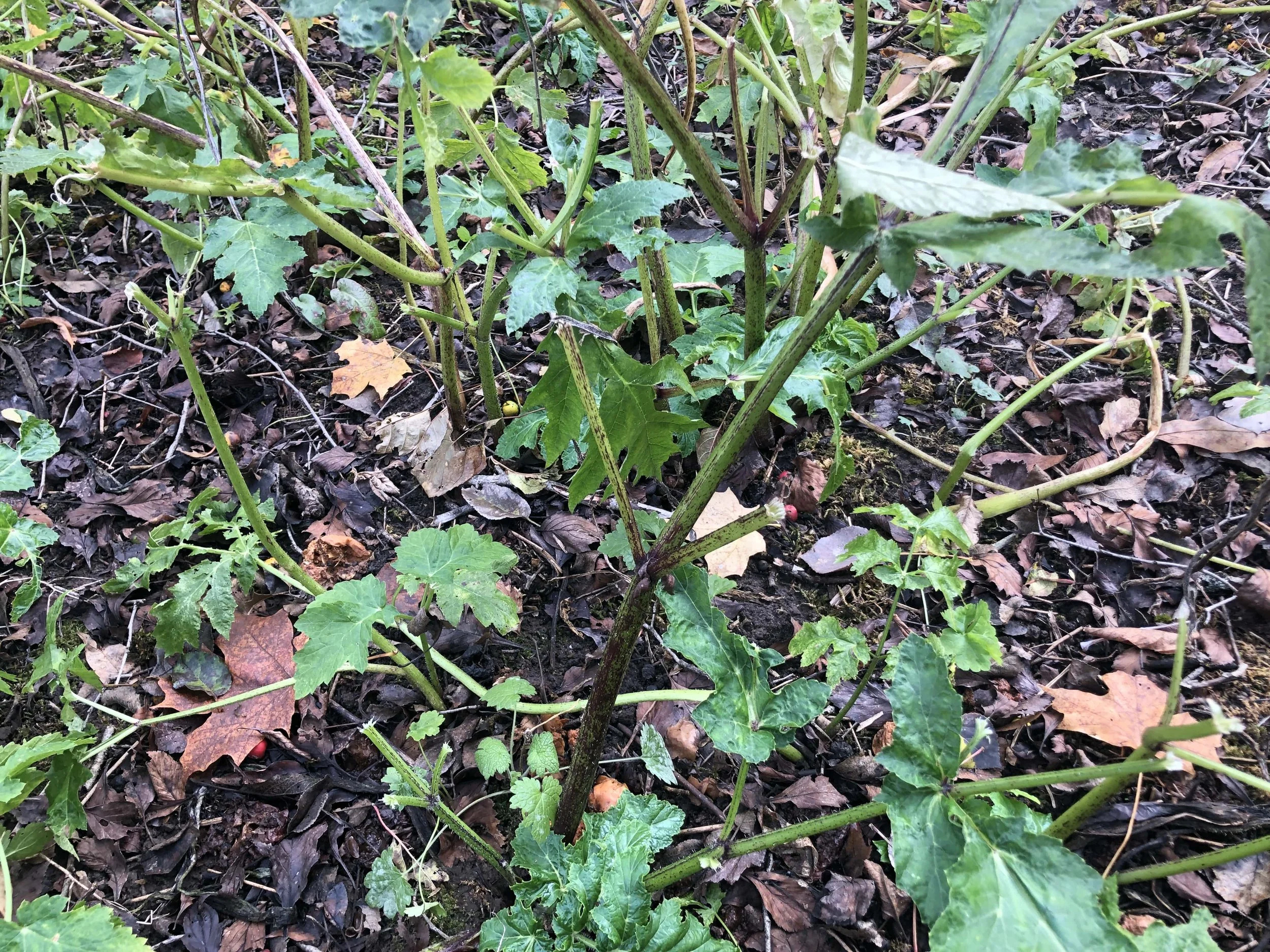
From this spot we walked on and found a ton more older rubs, a couple of newer ones, some containing fairly fresh tracks, and while unrelated to the rut, my favorite discovery of the day, sign of White-tail browsing thoroughly on a broad patch of Giant Hogweed (Heracleum mantegazzianum). This is going in my list of hazardous plants I have seen deer browse on. A couple others include Poison Ivy (Toxicodendron radicans), Water Hemlock (Cicuta maculata), and Canada Yew (Taxus canadensis). By now I recognize that what might affect us doesn’t seem to bother the deer, but it’s still exciting to see them going hard on plants that would likely kill me or make me very uncomfortable.
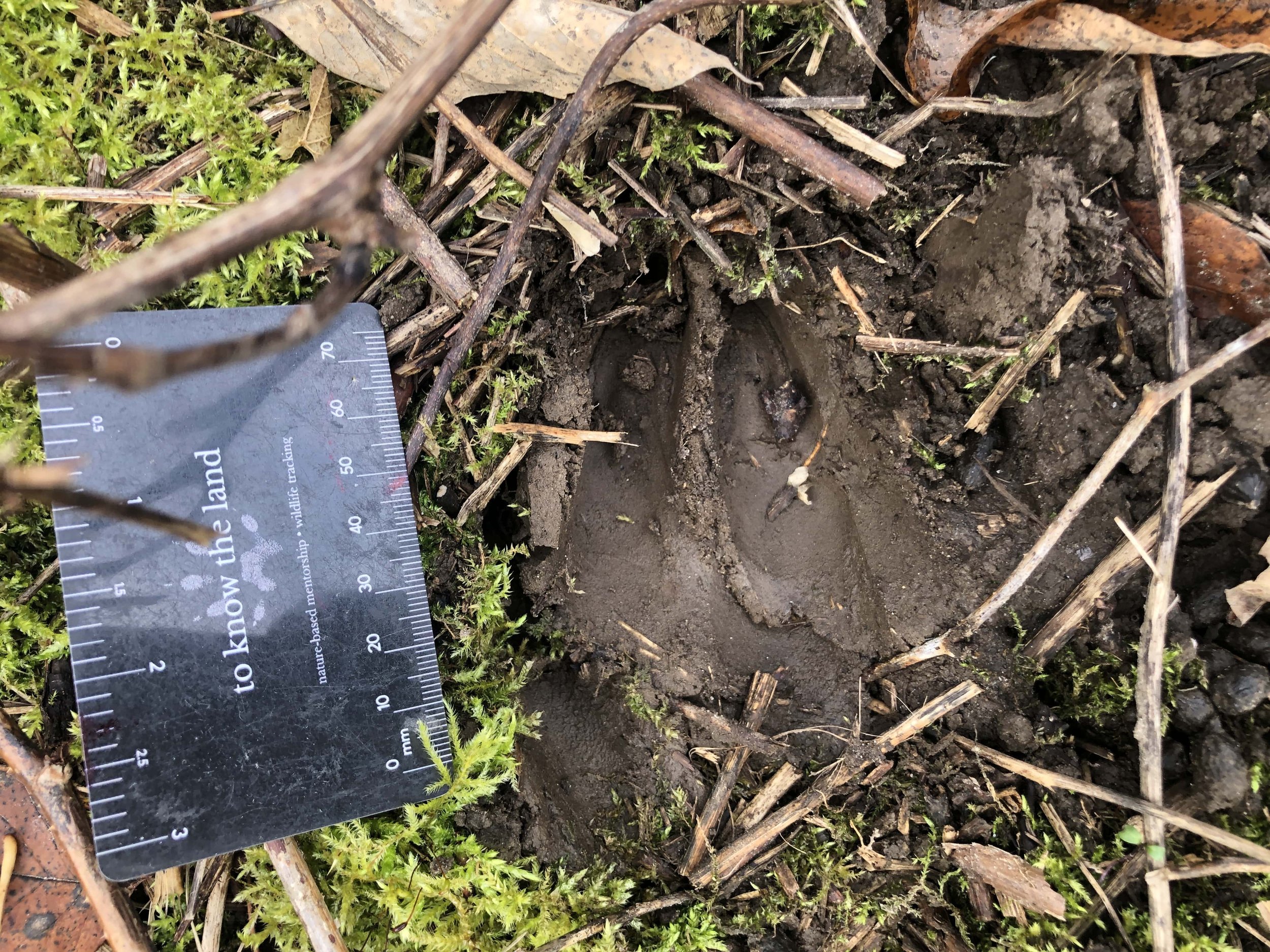
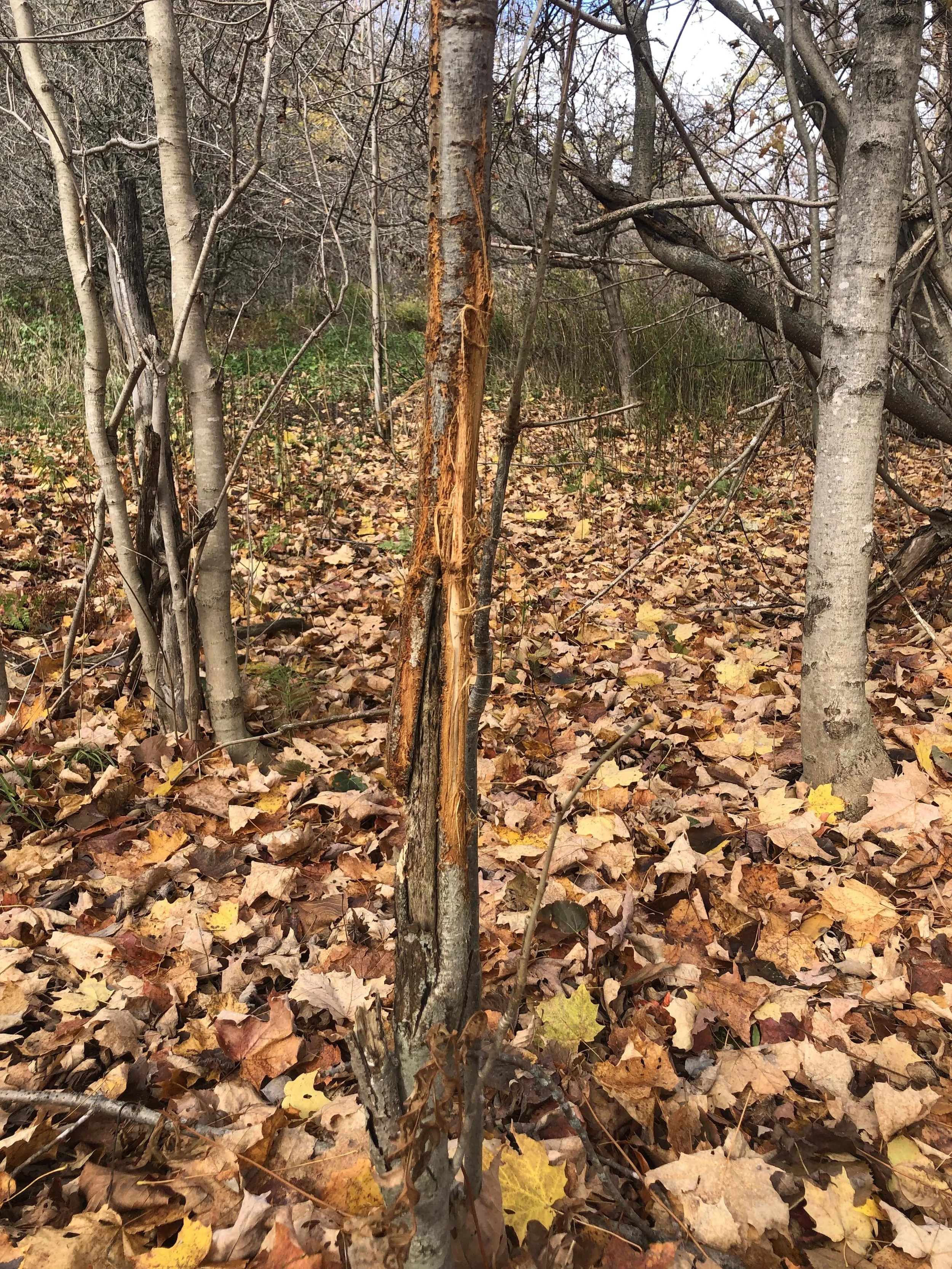
Scrapes full of glow in the dark urine, rubs which give off olfactory cues, from both the tree sap and pheromones from forehead glands and they give off visual cues as well through the exposed bright wood by day and luminescence by dusk and dawn, and lick branches wafting scents of saliva and preorbital glands. These all point to layered multisensory complex communication systems in the lead up to possible mating opportunities for the White-tailed Deer. While it may not be as we human animals do, other animals are still chatting away in the forest whether we care to listen to them or not.
To learn more :
Ep. 256 : Apple Scat of Coyotes and Red Fox
Glands on a White-tailed Deer Leg - I copied a lot of my information from that post and used it here as well.
Appearances can be Deceiving by Dan Strickland from The Raven talks about… DEER & MOOSE. The Friends of Algonquin Park, 2003.
Stokes Guide to Animal Tracking and Behaviour by Donald and Lillian Stokes, Little, Brown and Company, 1986.
Field & Stream : The Total Deer Hunter Manual by Scott Bestul & Dave Hurteau. Bonnier, 2013.
Rubs and Scrapes Glow Like Highway Reflectors to a Deer’s Eyes by Lindsay Thomas Jr.
Deer (The Wildlife Series, Book 3) edited by Duane Gerlach, Sally Atwater & Judith Schnell. Stackpole Books, 1995.
The Deer of North America by Leonard Lee Rue III. Lyons Press, 1997.